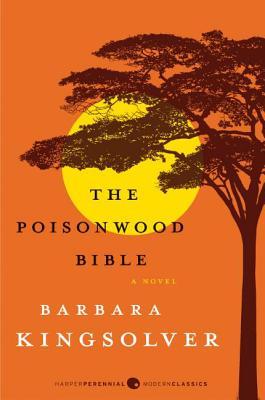
The Poisonwood Bible
Barbara Kingsolver
We may earn a commission on purchases — at no cost to you. As an Amazon Associate we earn from qualifying purchases. Disclosure.
The Poisonwood Bible follows the family of Nathan Price, a rigid Baptist missionary who drags his wife and four daughters to the Belgian Congo in 1959, on the eve of independence. Barbara Kingsolver tells it entirely through the five women's voices, tracing how the family disintegrates against a country in upheaval, and how each daughter reckons differently with guilt, faith and the wreckage their father's arrogance leaves behind. It is a family saga and a searching indictment of Western missionary and political interference in Africa.
- 1Nathan Price moves his family from Georgia to the village of Kilanga in the Congo in 1959, certain he can save souls and contemptuous of local knowledge.
- 2The novel is narrated in rotating chapters by his wife Orleanna and their four daughters, Rachel, Leah, Adah and Ruth May, never by Nathan himself.
- 3Nathan's mistranslated sermons render the phrase Tata Jesus is bangala as Jesus is poisonwood, an itching plant, rather than beloved, symbolising his failure to understand the culture.
- 4The story unfolds against real history: Congolese independence, the election and CIA-linked assassination of Patrice Lumumba, and the rise of the dictator Mobutu.
- 5The youngest daughter, Ruth May, dies of a snakebite, an event that finally breaks the family and frees Orleanna to leave Nathan.
- 6The surviving women scatter across Africa and America and spend the rest of their lives carrying the Congo and their guilt in different ways.
Key ideas
Five voices, no father
Kingsolver never lets Nathan narrate. The story is told by the women he controls, so the reader sees him only from outside, through the damage he does. This structure makes the book a study of the people a domineering man overshadows, and lets each daughter's distinct intelligence and blindness stand on its own.
The poisonwood sermon
Nathan's climactic sermons hinge on the word bangala, which means precious or beloved when spoken one way and the poisonwood plant when spoken another. He never masters the tonal difference, so he repeatedly tells the villagers Jesus is poisonwood. The mistranslation is Kingsolver's central emblem of missionary arrogance: certainty without understanding does harm.
The daughters as four responses to guilt
Rachel is vain and self-justifying and stays in Africa running a hotel while learning nothing; Leah marries a Congolese man and devotes herself to justice and atonement; Adah, disabled and brilliant, becomes a scientist skeptical of all faith; and Ruth May, the youngest, dies. Kingsolver uses them to map the range of ways the West has reckoned, or failed to reckon, with Africa.
Personal collapse against national history
The family's unravelling is deliberately synchronised with the Congo's. As Nathan's authority crumbles, so does colonial order; Lumumba's election, his overthrow with American backing, and Mobutu's dictatorship all press directly on the Prices' lives. Kingsolver ties the arrogance of one father to the arrogance of Cold War powers carving up a nation.
Orleanna's guilt and liberation
Orleanna narrates from years later, addressing her dead child, consumed by complicity in following Nathan and failing to protect her daughters. Ruth May's death is the catastrophe that finally lets her walk away. Her chapters give the novel its grief and its reckoning with a wife's responsibility inside a tyrannical marriage.
What the West owes and cannot repay
The novel argues that neither the Price family nor the nations they come from can undo the harm they caused, and that the honest response is to keep carrying it rather than seeking absolution. Leah's life of activism and Adah's clear-eyed science are offered not as solutions but as ways of living with an unpayable debt.
Who is it for?
Readers who want an ambitious, beautifully written family saga that doubles as serious postcolonial history will find this immensely rewarding, and the five distinct narrators make it a superb book club novel. It suits anyone interested in Africa, faith, and the legacy of Western intervention. Readers of Things Fall Apart or Half of a Yellow Sun will find it a powerful companion.
Full summary
In 1959, Baptist preacher Nathan Price transplants his family from Bethlehem, Georgia, to the tiny village of Kilanga in the Belgian Congo. He brings his wife Orleanna and daughters Rachel, the twins Leah and Adah, and little Ruth May, along with cake mix and garden seeds, expecting to reshape the village in his image.
Almost nothing works as Nathan planned. His garden fails because he ignores the tropical climate, his demand that villagers be baptised in the river founders because crocodiles make it lethal, and his preaching lands wrong because he cannot pronounce the local language correctly. The family survives largely through the help of neighbours he disdains.
Each daughter reacts differently. Rachel complains and clings to American vanity; Leah admires and then slowly loses faith in her father; Adah, who does not speak and reads the world sideways, observes everything; Ruth May befriends the village children. Orleanna struggles to keep them fed and alive as Nathan's rigidity endangers them all.
The Congo moves toward independence. The villagers hold their own democratic vote inside the church, humiliating Nathan, and the wider country elects Patrice Lumumba amid enormous hope. Political violence and Western interference begin to close in on the region.
Independence brings chaos rather than relief. Lumumba is deposed and, with covert American and Belgian involvement, assassinated; the dictator Mobutu rises. Supplies stop reaching Kilanga, drought and hunger set in, and the Prices, now abandoned by their mission, are trapped in a collapsing situation Nathan refuses to acknowledge.
Ruth May is bitten by a green mamba, deliberately placed near the house, and dies. Her death destroys what little held the family together. Orleanna, freed at last from paralysis, gathers her surviving daughters and walks out of Kilanga and away from Nathan, who stays behind.
The women disperse. Rachel drifts through marriages and ends up owning a hotel in French Equatorial Africa, unchanged. Leah marries Anatole, a Congolese teacher and activist, and raises a family in a life devoted to justice. Adah returns to America, has her body and speech partly restored, and becomes a research scientist.
Over the following decades the narrators reflect on the Congo, on Ruth May, and on their guilt. Nathan is eventually killed by villagers after further disasters. The novel closes with the women, and a final voice imagined as Ruth May's, urging the living to move forward carrying their history rather than being crushed by it.