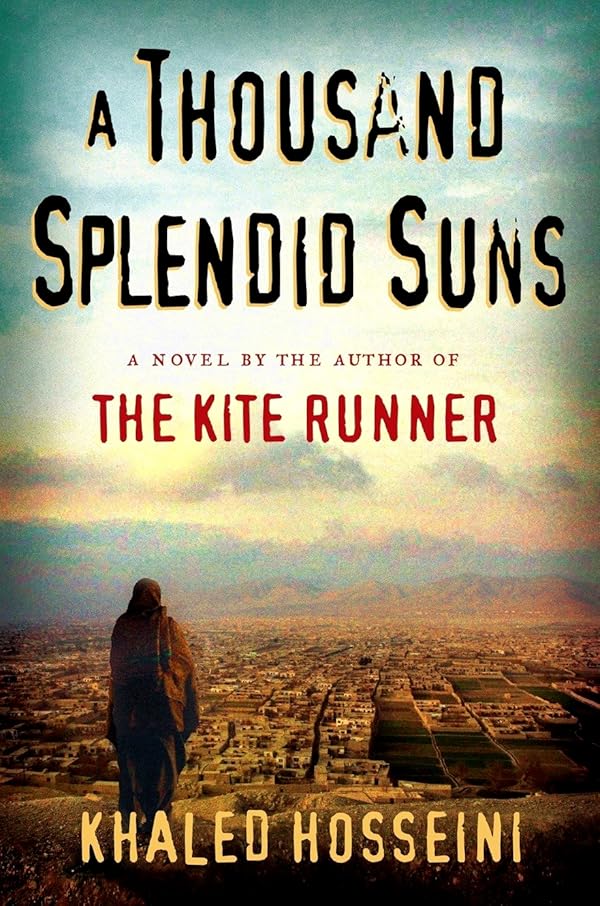
A Thousand Splendid Suns
Khaled Hosseini
We may earn a commission on purchases — at no cost to you. As an Amazon Associate we earn from qualifying purchases. Disclosure.
A Thousand Splendid Suns follows two Afghan women, Mariam and Laila, across thirty years of war, from the Soviet occupation to Taliban rule, who end up married to the same brutal man in the same Kabul house. Khaled Hosseini's second novel shifts his attention from fathers and sons to the women whose lives were shaped by each successive regime, and argues that endurance and female friendship are their own form of heroism. It is a story about how strangers forced together by circumstance become the family neither of them was allowed to choose.
- 1Mariam is the illegitimate daughter of a wealthy Herat cinema owner and his housekeeper, raised in a hut outside town and married off at fifteen to Rasheed, a Kabul shoemaker thirty years older.
- 2Laila, born in Kabul a generation later to educated parents, loses her family to a rocket strike and is taken into the same household after Rasheed manipulates her into marriage.
- 3The two women begin as rivals and become the central relationship of the book, allied against a husband whose violence escalates through the years.
- 4Successive regimes narrow the women's world: the Soviet era gave Laila school and ambition, the mujahideen years brought street fighting, and the Taliban made it illegal for her to leave the house alone or work.
- 5Mariam kills Rasheed with a shovel to stop him strangling Laila, then confesses so that Laila and the children can escape.
- 6Mariam is publicly executed at Ghazi Stadium, and Laila later returns from Pakistan to Kabul to rebuild the orphanage where her daughter had been hidden.
Key ideas
The harami and the inherited insult
Mariam grows up with her mother Nana's bitter instruction that she is a harami, an illegitimate child, and that a man's accusing finger always finds a woman. Her adoration of her father Jalil collapses the day she walks to his house and is left sleeping on the street. Everything that follows, including her acceptance of Rasheed, is shaped by having been taught she deserves nothing.
Two generations of Afghan womanhood
Laila's father Babi tells her that a society has no chance if its women are uneducated, and she grows up in Soviet-era Kabul with school and a future in mind. Mariam grew up with a mullah, a Koran and a hut. Putting them in one house lets Hosseini show what was gained and then taken away within a single lifetime.
Rasheed and the domestic face of ideology
Rasheed demands the burqa long before the Taliban require it, forces Mariam to chew pebbles after a poorly cooked meal, and starves the family while keeping food for his son Zalmai. He is not a fanatic, he is an ordinary man whose private tyranny is progressively legitimised by whoever holds Kabul. His shoe shop burning down and his slide into poverty make him more dangerous, not less.
Friendship as rescue
The turn comes when Laila's baby daughter Aziza is born and Mariam, who has lost seven pregnancies, is drawn to her. Tea on the floor, a shared escape attempt that fails at the bus station, and years of small conspiracies build a bond stronger than either woman's marriage. Hosseini's claim is that this relationship, not any rescuer, is what saves them.
The cost of the choice at the end
When Rasheed is strangling Laila, Mariam takes a shovel to him, then refuses to run. She reasons that a legitimate departure requires someone to answer for it, and she wants Laila's freedom to be permanent rather than fugitive. Her calm in the Ghazi Stadium, thinking of herself as a woman who has loved and been loved, reframes a life she was told meant nothing.
Kabul as a character
The city is described street by street across three decades, from the cinemas and university of the 1970s to rubble, checkpoints and the destruction of the Bamiyan Buddhas. The title comes from a seventeenth-century poem by Saib-e-Tabrizi about Kabul, quoted by Babi as the family flees. The novel closes with reconstruction beginning, a deliberate note of hope.
Notable quotes
“the thousand splendid suns that hide behind her walls”
— Saib-e-Tabrizi, quoted by Babi
Who is it for?
Readers who found The Kite Runner powerful and want something with even more emotional range will likely rate this one higher, and it is the book to reach for if you want to understand Afghan history through the people who lived inside it rather than through headlines. It rewards book clubs with rich material on marriage, motherhood, sacrifice and female solidarity. Readers of Half of a Yellow Sun or The Bookseller of Kabul will feel at home.
Full summary
Mariam grows up in a hut outside Herat with her embittered mother Nana, visited weekly by her wealthy father Jalil, who tells her stories and never takes her home. On her fifteenth birthday she walks to his house to demand a place in it, is refused entry, and returns to find Nana has hanged herself.
Jalil's wives arrange her marriage to Rasheed, a shoemaker in Kabul three decades her senior. He is briefly kind, then insists on the burqa, then turns violent after a series of miscarriages leaves the couple childless. Mariam's world narrows to one house and one man's moods.
Nearly twenty years later and a few doors away, Laila is growing up in Soviet-era Kabul with a schoolteacher father who believes in her education and a mother lost to grief for two sons at the front. Laila and her friend Tariq fall in love as teenagers, and he leaves for Pakistan with his family as the fighting closes in.
A rocket destroys Laila's house and kills both her parents. Rasheed pulls her from the rubble, nurses her, and then produces a man who reports that Tariq died of his wounds in Peshawar. Pregnant and with nothing left, Laila accepts Rasheed's proposal to protect the child.
Mariam treats her as a usurper until Aziza is born. The two women slowly build an alliance in the kitchen and the courtyard, hiding food, sharing tea, and eventually attempting to flee to Pakistan. They are caught at the bus station, returned by the police, and beaten and locked up by Rasheed.
The Taliban take Kabul. Women are barred from work, education and leaving home unaccompanied, and the hospital where Laila delivers her son Zalmai by caesarean has no anaesthetic. As Rasheed's business fails, Aziza is sent to an orphanage to be fed, and Laila is beaten by Taliban patrols on the way to visit her.
Tariq appears at the door, alive: the report of his death was bought and staged by Rasheed. When Zalmai innocently reveals the visit, Rasheed attacks Laila and begins to strangle her. Mariam fetches a shovel from the toolshed and kills him with it.
Mariam sends Laila, Tariq and the children to Pakistan and turns herself in, and is executed at Ghazi Stadium after a brief Taliban hearing. Years later, after the regime falls, Laila and Tariq return to Kabul, visit the hut where Mariam grew up, and rebuild the orphanage in Deh Mazang, where Laila teaches.