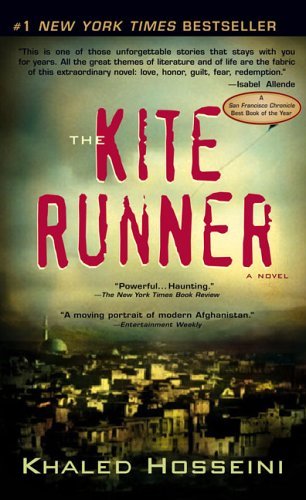
The Kite Runner
Khaled Hosseini
We may earn a commission on purchases — at no cost to you. As an Amazon Associate we earn from qualifying purchases. Disclosure.
The Kite Runner follows Amir, a privileged boy in 1970s Kabul, who betrays his closest friend Hassan and spends the next quarter century trying to live with it. Khaled Hosseini uses one act of cowardice in an alley to trace Afghanistan's own collapse, from the last calm years of the monarchy through the Soviet invasion, exile in California and the Taliban. The book's argument is that guilt does not fade with distance or success, and that redemption, when it comes, costs something real.
- 1Amir is the son of a wealthy Pashtun businessman in Kabul; Hassan is the son of their Hazara servant, and the two boys grow up together as friends and as unequals.
- 2The novel's pivot is Amir watching Assef assault Hassan in an alley after the 1975 kite tournament and choosing to run rather than intervene.
- 3Amir compounds the betrayal by planting money and a watch under Hassan's mattress to force him and his father Ali out of the house.
- 4Rahim Khan's phone call decades later reveals that Hassan was Baba's illegitimate son, making Amir's betrayed friend his half-brother.
- 5Amir returns to Taliban-run Kabul to rescue Hassan's orphaned son Sohrab and confronts Assef, now a Taliban official, in a beating that leaves Amir feeling healed rather than broken.
- 6Kite fighting and the phrase that Hassan uses to promise loyalty frame the book, and both return in the closing scene with Sohrab in California.
Key ideas
One moment that never stops happening
The winter of 1975 supplies the novel's engine: Hassan runs down the last cut kite for Amir, is cornered by Assef, and Amir watches from the shadows. Everything after that is Amir arranging his life around not thinking about it. Hosseini's insight is that the wound is not the event but the silence built on top of it.
Ethnic hierarchy inside a friendship
Amir is Pashtun and Sunni, Hassan is Hazara and Shia, and the gap shapes everything even when the boys do not name it. Assef taunts Hassan with slurs about flat noses and mice-eaters, and Amir privately reminds himself that Hassan is only a servant. The book shows how a country's prejudices work through the most affectionate relationships in it.
Baba's double life and its cost
Baba builds an orphanage, wrestles a bear in family legend, and stands up to a Russian soldier to protect a stranger, yet he cannot acknowledge his own son by Ali's wife. His constant disappointment in Amir is partly guilt at the love he cannot show Hassan openly. Rahim Khan puts it plainly: a man who steals the truth from his son steals his right to a father.
Exile shrinks a man and reveals him
In Fremont, California, Baba goes from Kabul aristocrat to gas station attendant selling secondhand goods at the San Jose flea market. The Afghan community rebuilds itself around General Taheri's rituals of honour and reputation. Amir finally earns his father's respect through writing, and marries Soraya, whose past has already been publicly judged in a way his never was.
Redemption has to be physical
Hosseini does not let Amir apologise his way out. He has to fly back into Taliban Afghanistan, see the stadium executions, find Sohrab dressed and made up in Assef's house, and take a beating so severe that his split lip mirrors Hassan's cleft palate. Only in that violence does Amir report feeling at peace for the first time since 1975.
The damaged child and the slow ending
Sohrab is not a prize to be won. He attempts suicide when a bureaucratic obstacle threatens to send him back to an orphanage, then stops speaking for nearly a year in America. The final scene offers only a single flicker of a smile as Amir runs a kite for him, and Hosseini deliberately refuses anything larger.
Notable quotes
“For you, a thousand times over.”
— Hassan, and later Amir
Who is it for?
Readers who want a big, emotionally direct story with a clear moral spine will race through this, and it is a superb entry point for anyone whose sense of Afghanistan comes only from news footage. It rewards book clubs and classrooms with real material on guilt, class, fatherhood and immigration. Anyone who loved A Thousand Splendid Suns or The Book Thief will recognise the same combination of sweep and intimacy.
Full summary
Kabul in the early 1970s is calm and comfortable for Amir, the motherless son of a prominent businessman known as Baba. His constant companion is Hassan, the Hazara boy who serves the household with his father Ali, and who is loyal past the point of reason. Amir craves a father's approval he never feels he has earned.
In the winter of 1975 Amir finally wins the citywide kite tournament, and Hassan runs to retrieve the last cut kite as a trophy. Assef, a sadistic older boy with a fondness for Hitler, corners him in an alley and assaults him when Hassan refuses to hand the kite over. Amir sees it and says nothing.
Unable to live beside the person who reminds him of his cowardice, Amir plants his birthday money and watch under Hassan's mattress and accuses him of theft. Hassan, understanding exactly what is happening, confesses to a crime he did not commit. Baba forgives him instantly, and Ali takes his son away regardless.
The Soviets invade in 1979. Baba and Amir escape in a fuel truck and eventually reach California, where the wealthy Kabul patriarch pumps gas and sells junk at the flea market. Amir goes to college, publishes a novel and marries Soraya Taheri. Baba dies of cancer soon after the wedding, still unaware his son knows nothing of his secret.
In 2001 Rahim Khan calls from Pakistan and tells Amir there is a way to be good again. He explains that Hassan and his wife were executed by the Taliban in Kabul, that their son Sohrab is in an orphanage, and that Hassan was Baba's son, making him Amir's half-brother.
Amir enters Afghanistan with a false beard and a guide named Farid, and finds a ruined country where the Taliban stone adulterers at half time in the football stadium. The orphanage director tells him a Talib official has taken Sohrab. That official turns out to be Assef.
Assef agrees to release the boy only after a fight. He beats Amir with brass knuckles until Sohrab fires a brass ball from his slingshot into Assef's eye, a direct echo of a threat Hassan once made in the same situation. They escape to Pakistan, and Amir is hospitalised with a ruptured spleen and a split lip.
Adoption proves nearly impossible, and when Amir mentions the possibility of a temporary return to an orphanage, Sohrab tries to kill himself. He survives, comes to California, and stops speaking. The novel closes at a kite-flying gathering in Fremont, where Amir runs a cut kite for Sohrab and repeats Hassan's old promise back to his son.