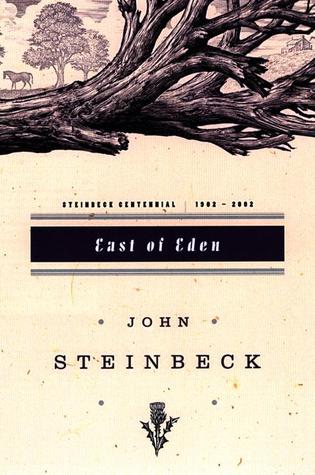
East of Eden
John Steinbeck
We may earn a commission on purchases — at no cost to you. As an Amazon Associate we earn from qualifying purchases. Disclosure.
East of Eden is John Steinbeck's epic novel spanning generations of two families in California's Salinas Valley, tracing their moral struggles and their intertwined fates from the Civil War through World War I. Steinbeck explores the battle between good and evil through multiple generations and asks whether humans are capable of moral choice or whether they are prisoners of inherited sin. It is Steinbeck's most ambitious work, a portrait of American life and moral philosophy.
- 1The novel follows the Trask and Hamilton families across generations, beginning with Adam Trask and his wife Catherine, a woman of dark moral character.
- 2Adam and Catherine have two sons, Caleb and Aron, whose sibling rivalry echoes the biblical story of Cain and Abel.
- 3Caleb struggles to win his father's approval and love, while Aron is favoured, creating a dynamic of jealousy and resentment.
- 4Samuel Hamilton, a wise neighbour and friend, observes the family's struggles and offers moral guidance.
- 5The novel traces how moral choices made in one generation affect those that follow.
- 6Central to the novel is the question of whether humans have free will to choose goodness or whether they are bound by inherited sin.
Key ideas
The battle between good and evil
Steinbeck portrays good and evil as fundamental human forces that exist in each person. The battle between them is the central human struggle.
Choice and free will
Through the concept of 'timshel,' Steinbeck suggests that humans have the power to choose, to overcome their nature and their inheritance.
Parental love and rejection
The novel explores how parental love or rejection shapes children and how children's attempts to win parental approval drive their lives.
Sibling rivalry
The Cain and Abel story is repeated through the Trask brothers, suggesting that sibling rivalry and the desire for parental approval are fundamental human conflicts.
The influence of place
The Salinas Valley is portrayed as a specific place with a specific moral character, and the novel is partly a portrait of America itself.
Generational cycles
Steinbeck explores how patterns repeat across generations and how breaking these cycles requires conscious moral choice.
Who is it for?
Readers who want Steinbeck's most ambitious and philosophically complex work will find this essential. It suits anyone interested in American literature, moral philosophy or multigenerational family sagas. Readers should be prepared for the novel's length and complexity.
Full summary
East of Eden follows two families, the Trasks and the Hamiltons, across generations in California's Salinas Valley from the Civil War through World War I.
Adam Trask is a decent man who marries Catherine, a woman of mysterious and dark moral character. Catherine is beautiful but without conscience.
Adam and Catherine have twin sons: Caleb, dark and difficult, and Aron, light and favoured. Adam loves Aron immediately and struggles with Caleb.
Catherine abandons her family when the boys are young, leaving Adam to raise them. She becomes a brothel madam, suggesting a capacity for evil and cruelty.
Samuel Hamilton, Adam's neighbour and friend, is a wise man who observes the family struggles and offers moral guidance and friendship to Adam.
As the boys grow, Caleb seeks his father's love and approval, but Adam's preference for Aron remains absolute. Caleb's resentment and rejection drive him toward cruelty.
The boys grow into manhood during World War I. Aron joins the army, and Caleb, denied his father's love despite his efforts, turns toward darkness.
The novel ends with Adam and Caleb facing each other in a final moment of moral reckoning, where Adam must choose whether to bless Caleb or reject him, and Caleb must choose whether to accept his nature or to transcend it.