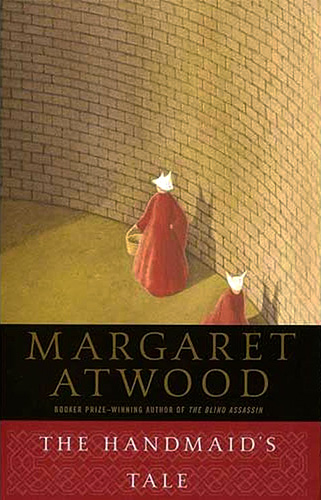
The Handmaid’s Tale
Margaret Atwood
We may earn a commission on purchases — at no cost to you. As an Amazon Associate we earn from qualifying purchases. Disclosure.
The Handmaid's Tale is Margaret Atwood's dystopia about Offred, a woman assigned as a reproductive servant in Gilead, a theocratic regime that has overthrown the United States after a fertility collapse. Atwood built the novel on a rule she set herself: every atrocity in it had already happened somewhere in history. It is a warning about how quickly rights can be stripped, how religious fundamentalism can be turned into state policy, and how ordinary life adapts to horror one concession at a time.
- 1A plummeting birth rate, caused by pollution and disease, is the pretext for a coup that replaces the US government with the Republic of Gilead.
- 2Fertile women are conscripted as Handmaids and assigned to elite households to bear children for Commanders and their wives.
- 3Offred, meaning of-Fred, is stripped of her real name; the monthly Ceremony in which the Commander attempts to impregnate her is ritualised state rape overseen by his wife.
- 4Women are forbidden to read, own property or hold money, and the transition happened fast, within the narrator's own adult memory.
- 5Offred's Commander breaks the rules by meeting her privately, while his wife Serena Joy arranges for her to sleep with the chauffeur Nick to conceive.
- 6The novel ends ambiguously as Offred is taken away in a van, unsure whether to the resistance or to arrest, and a closing academic epilogue reveals Gilead eventually fell.
Key ideas
Everything in it has really happened
Atwood's governing rule was to include no invented atrocity, only ones with historical precedent: public executions, forced childbearing, the seizure of women's bank accounts, book bans, reproductive coercion. This is why the book reads as warning rather than fantasy. Gilead is assembled from things human societies have already done.
How fast normal can end
Offred remembers her ordinary former life, her job, her husband Luke, her daughter, and can trace the exact steps by which it was dismantled: her bank card frozen, women fired in a single day, escape attempts failing at the border. Atwood's chilling point is how each step seemed survivable until, together, they were not.
Language as control
Gilead governs through scripture and slogan. Greetings are fixed phrases, the shops have pictorial signs because women may not read, and titles like Handmaid, Wife, Martha and Aunt reduce women to functions. Offred hoards words privately, and the Latin phrase scratched in her closet by a predecessor becomes an act of resistance simply by existing.
Women enforcing the system
The regime is policed substantially by women. The Aunts indoctrinate and punish the Handmaids with cattle prods, and the Wives, like Serena Joy, a former televangelist who campaigned for exactly these values, wield domestic power over the women beneath them. Atwood refuses to make oppression purely a matter of men against women.
Complicity and small rebellions
The Commander wants ordinary company, games of Scrabble, forbidden magazines, and treats his transgressions as generosity. Offred's resistance is mostly interior and modest: remembering, narrating, feeling desire, staying alive. Atwood is interested in the compromises real people make under tyranny rather than heroic defiance.
The epilogue that reframes everything
The novel closes with notes from a future academic conference studying Gilead as history, discussing Offred's account as a recovered artefact. The device confirms that Gilead fell, gives the narrative distance, and drily satirises how scholars can discuss a woman's suffering as a research problem, missing the person inside it.
Notable quotes
“Nolite te bastardes carborundorum.”
— scratched in the closet
Who is it for?
Readers who want a foundational feminist dystopia that has only grown more discussed with time will find it essential and disturbingly plausible. It rewards anyone thinking about reproductive rights, religious politics and how democracies erode. Readers of 1984, Never Let Me Go or Station Eleven will find it in conversation with all of them.
Full summary
Offred lives in the Republic of Gilead, formerly part of the United States, in a near future where widespread infertility has become a crisis. She is a Handmaid, one of the few remaining fertile women, assigned to the household of a high-ranking Commander and his wife to bear them a child.
Her days are tightly controlled: she may leave only to shop, always paired with another Handmaid, always in the red habit and white wings that mark her role. She is forbidden to read, to be alone, or to use her former name. Through fragments, she recalls the life she had before, with a husband and daughter now lost to her.
She narrates how Gilead came to be. A staged attack blamed on terrorists suspended the constitution; women were abruptly barred from working and from controlling money; escape routes closed. Her own attempt to flee to Canada with Luke and their child failed, and she was captured and re-educated by the Aunts at a training centre.
The central ritual is the monthly Ceremony, in which the Commander tries to impregnate Offred while his wife, Serena Joy, holds her, a coldly formalised assault justified by scripture. Serena, once a public campaigner for traditional gender roles, now lives trapped inside the world she helped build.
The Commander begins summoning Offred to his study at night, against every rule, wanting conversation, Scrabble and small forbidden gifts. These meetings are dangerous and strangely intimate, and reveal his loneliness and self-justification more than any real kindness.
Desperate for a child, and suspecting her husband is infertile, Serena arranges for Offred to sleep secretly with Nick, the household chauffeur. Offred and Nick continue the affair beyond its purpose, and she begins to feel something real, which frightens her because it gives Gilead a new hold over her.
Offred learns of Ofglen, her shopping partner, who belongs to an underground resistance called Mayday, and glimpses the possibility of escape or rebellion. Ofglen is exposed and takes her own life before she can be arrested, and Serena discovers evidence of Offred's nights with the Commander.
A black van arrives for Offred. Nick tells her to trust the men, that they are Mayday, but she cannot be sure they are not the secret police. She steps into the van not knowing whether she is being rescued or destroyed. A closing academic epilogue, set long after Gilead has fallen, presents her story as a historical document.