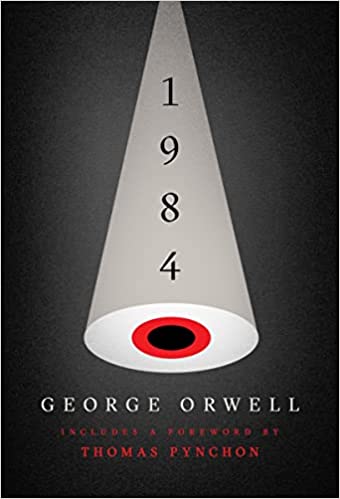
1984
George Orwell
We may earn a commission on purchases — at no cost to you. As an Amazon Associate we earn from qualifying purchases. Disclosure.
1984 is George Orwell's dystopia about Winston Smith, a low-ranking Party member in a totalitarian superstate that controls not only action and speech but memory and thought itself. Orwell projects the methods of mid-century totalitarianism to their logical end, imagining a regime that rewrites the past continuously, wages permanent war, and can make a person believe two plus two equals five. Its lasting power is that it names its own weapons, doublethink, Newspeak, the memory hole, Big Brother, so precisely that the words entered the language as warnings.
- 1Winston Smith works at the Ministry of Truth in Oceania, rewriting historical records so they always match the Party's current position.
- 2The Party's slogans, War is Peace, Freedom is Slavery, Ignorance is Strength, capture its method of holding contradictory beliefs simultaneously, which it calls doublethink.
- 3Newspeak is a language being deliberately stripped of words so that dissenting thought becomes literally impossible to formulate.
- 4Winston begins an illicit affair with Julia and believes he has joined a resistance called the Brotherhood, led by the enemy figure Emmanuel Goldstein.
- 5The whole rebellion is a trap: O'Brien, whom Winston trusted, is a Party agent who has been watching him for seven years.
- 6In Room 101, Winston is broken by his worst fear and betrays Julia, and the novel ends with him loving Big Brother, his resistance not merely defeated but erased.
Key ideas
Control of the past as control of everything
Winston's job is to alter old newspapers so the Party is never shown to have been wrong, dropping the originals into memory holes to be incinerated. The Party's principle is that whoever controls the past controls the future. Orwell's insight is that a regime that owns memory owns reality, because there is no external record left to appeal to.
Doublethink and the destruction of logic
The Party demands that people hold two contradictory beliefs at once and accept both, forgetting that they ever contradicted. This lets a citizen record a lie and sincerely believe the truth in the same moment. It is the mechanism that makes the slogans function and the reason Winston can eventually be made to see five fingers when four are held up.
Newspeak as thought control
The appendix on Newspeak describes a language engineered so that heretical concepts have no words to express them. Remove the word free in its political sense and, the theory goes, you remove the possibility of the thought. Orwell treats language not as a mirror of thought but as its precondition.
Surveillance and the interior life
Telescreens watch and listen in every room and cannot be turned off, so Winston's only privacy is a small alcove and the inside of his own skull. Even a facial expression can be a crime, called facecrime. The Party's ambition is not just obedience but the elimination of any private self at all.
The rebellion that was always a trap
Winston's rented room, his diary, his affair with Julia, and his recruitment by O'Brien into the Brotherhood all feel like genuine resistance. Every step was monitored and often arranged. Orwell's bleakest move is to show that the regime does not merely punish dissent, it manufactures and harvests it.
Room 101 and the breaking of the self
The Party is not satisfied with obedience or even confession; it requires that the victim genuinely love Big Brother. In Room 101, O'Brien uses Winston's terror of rats to force him to betray Julia, to wish the torture onto her instead. That betrayal, of the one thing he had sworn to keep, is what finally empties him out.
Why the ending is total
Orwell refuses any consoling glimmer. Winston is released, ruined, and sits in a cafe genuinely loving the leader who destroyed him. The appendix, written in the past tense about Newspeak, hints that Oceania eventually fell, but within the story itself the defeat of the individual is complete.
Notable quotes
“War is Peace. Freedom is Slavery. Ignorance is Strength.”
— Party slogans, Ch. 1
Who is it for?
Readers who want the foundational text on totalitarianism, surveillance and propaganda will find it as sharp and unsettling as its reputation promises, and its vocabulary has become part of how we discuss power. It rewards anyone thinking about media, truth and political language today. Readers of Brave New World, Fahrenheit 451 or The Handmaid's Tale should treat this as the cornerstone of the shelf.
Full summary
Winston Smith lives in London, capital of Airstrip One, a province of the superstate Oceania ruled by the Party and its unseen figurehead Big Brother. Telescreens watch every citizen constantly. Winston works at the Ministry of Truth, editing the historical record so that the Party is never contradicted by its own past.
Quietly appalled by a life he cannot remember choosing, Winston commits his first crime: he buys a diary and begins writing his private thoughts, an act punishable by death. He is drawn to O'Brien, a senior Inner Party member he suspects of secret dissent, and to the possibility of an underground resistance.
He begins a dangerous affair with Julia, a younger colleague who hides cheerful rebellion beneath outward zeal. They rent a room above a junk shop in the proletarian district, believing it free of surveillance, and treat their relationship as an act of defiance against a Party that wants to abolish desire.
O'Brien makes contact and inducts them into what he says is the Brotherhood, the resistance led by the traitor Emmanuel Goldstein. He gives Winston Goldstein's forbidden book, which explains the true structure of Oceania: perpetual war between three superstates that exists only to consume production and keep populations poor and fearful.
The room is raided. It had been watched all along; the shopkeeper is a member of the Thought Police, and O'Brien is a loyal Party agent who has been studying Winston for years. Winston and Julia are separated and taken to the Ministry of Love.
O'Brien tortures and re-educates Winston over weeks, explaining that the Party seeks power purely for its own sake and intends to control reality itself. He makes Winston accept, genuinely, that the Party can decide how many fingers it is holding up. Winston confesses to everything and betrays almost everyone, but holds onto his love for Julia.
That last loyalty is taken from him in Room 101, where each prisoner meets their worst fear. Faced with a cage of rats fitted to his face, Winston screams for it to be done to Julia instead. In that instant he betrays her utterly, which is the surrender the Party was waiting for.
Released as a hollow man, Winston runs into Julia once; each admits having betrayed the other, and neither cares. He spends his days drinking in a cafe, doing trivial work, and waiting for the bullet he knows will one day come. The final line finds him weeping with love for Big Brother.