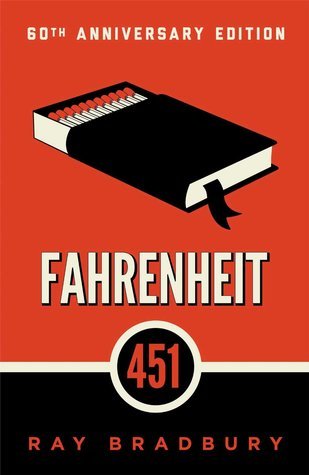
Fahrenheit 451
Ray Bradbury
We may earn a commission on purchases — at no cost to you. As an Amazon Associate we earn from qualifying purchases. Disclosure.
Fahrenheit 451 is Ray Bradbury's dystopian novel about a fireman named Guy Montag who, in a future American society where books are banned, has the job of burning them. When Montag begins to question the world he serves and reads a book himself, he sets in motion a personal and philosophical rebellion against a system designed to suppress thought and individuality. It is a meditation on censorship, the power of literature, and the human need for meaning in a world engineered for comfort and conformity.
- 1Guy Montag is a fireman in a dystopian future where firemen burn books rather than save buildings from fire.
- 2A young girl named Clarisse meets Montag and asks him questions that make him doubt the world he has accepted uncritically.
- 3Montag's wife Mildred is addicted to television and sedatives, representing the pleasures of passivity and distraction that the society offers.
- 4Montag steals a book and begins to read it, an act that transforms him and forces him to confront what his society has made him do.
- 5Captain Beatty, Montag's boss, represents the system's seductive logic: books are confusing and dangerous, burn them and everyone is happy.
- 6Montag flees his burning city and joins a community of people who preserve books by memorising them, suggesting that literature's power cannot be entirely suppressed.
Key ideas
Censorship through pleasure
Bradbury's insight is that the future will not censor through force alone but through seduction. Television, sedatives, entertainment and distraction are more effective at suppressing thought than any overt tyranny. The society has engineered contentment through the elimination of discomfort, including the discomfort of challenging ideas.
The numbing of intelligence
The novel asks what happens when society devalues reading and thought, replacing depth with speed and entertainment. Bradbury suggests that without literature, conversation and intellectual engagement, humans become passive, lonely and dependent on systems designed by others. Intelligence atrophies without use.
Individual questioning as revolution
Montag's rebellion begins small and personal: he asks a question, he reads a book, he doubts. Bradbury treats individual thought and curiosity as revolutionary acts in a society designed to suppress them. The personal is political; individual awakening is an affront to the system.
The power of memorised books
The community Montag joins preserves books by memorising them, suggesting that ideas cannot be entirely destroyed. Knowledge, once transmitted, lives in human minds and can be reborn. Bradbury argues for the resilience of literature and human memory against systematic erasure.
Connection and isolation
Montag is isolated in his marriage and his work until he meets Clarisse, whose questions awaken him. Bradbury suggests that genuine human connection and dialogue are what awaken us, and that isolation and passive entertainment are the real mechanisms of control.
Beauty and terror in words
As Montag reads, he discovers that words are beautiful and dangerous, comforting and challenging. Books offer the full range of human experience, while the society offers only the pleasant parts. Bradbury argues for the necessity of complexity and challenge, not just happiness.
Notable quotes
“There is more than one way to burn a book.”
— Beatty, on the suppression of ideas
Who is it for?
Readers who want a foundational science fiction critique of censorship and conformity will find this essential and startlingly prescient. It suits anyone interested in the power of literature, the dangers of technology-driven distraction, or dystopian futures. Readers of 1984 or Brave New World will recognise its kinship.
Full summary
Guy Montag is a fireman in a future American society where the job of firemen is not to save buildings from fire but to burn books and the houses that contain them. The society has deemed books dangerous and confusing, and their systematic destruction is an accepted part of the social order.
Montag has been a fireman for years without questioning his work until he meets Clarisse McClellan, a young girl who asks him thought-provoking questions about the world and whether he is truly happy. Her questions linger and make him uneasy.
Montag's home life, by contrast, is dominated by his wife Mildred, who spends her time watching television, taking sedatives and ignoring her husband. She represents the pleasures and addictions the society offers: distraction, entertainment, emotional numbness.
As Montag performs his work, burning books, he begins to question it. He steals a book from a house he is supposed to burn, and when he reads it, he feels something awakening inside him. The book offers complexity, contradiction, depth, everything his society has tried to eliminate.
His captain, Beatty, who is urbane, intelligent and entirely committed to the system, tries to explain the logic of book-burning: books are confusing and divisive, and burning them has brought peace and happiness. Beatty represents the seductive logic of the system, the intelligent case for stupidity.
Montag's theft of a book and his secret reading set him at odds with his society. His wife turns him in, his captain comes to arrest him, and his life unravels as he recognises that the comfort he has lived in is a kind of death.
Montag flees his city and his burning home. He encounters a community of people who have dedicated themselves to preserving books by memorising them, each person committing an entire book to memory so that literature survives even when burned. They offer him hope and a path forward.
Bradbury ends the novel with the city behind them burning, destroyed by war or its own logic, and the community of book-keepers facing an uncertain future but carrying literature within them. The novel closes with Montag quoting Ecclesiastes and thinking about rebuilding.