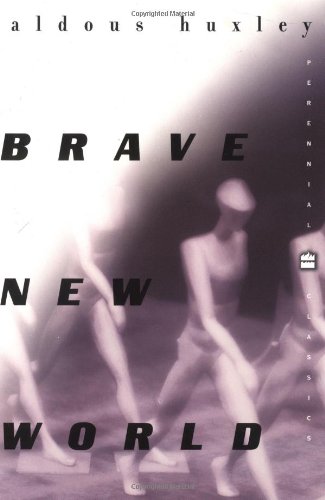
Brave New World
Aldous Huxley
We may earn a commission on purchases — at no cost to you. As an Amazon Associate we earn from qualifying purchases. Disclosure.
Brave New World is Aldous Huxley's dystopian masterpiece about a future world where human misery has been eliminated through conditioning, pleasure-maximising drugs and the elimination of choice and freedom. When Bernard Marx, a member of this perfectly stable society, brings a visitor from outside into the World State, the arrival of the 'savage', John, who has been raised on Shakespeare and human passion, reveals the price of stability: the complete erasure of authentic human experience. It is a novel about the seductive power of comfort and the terrible cost of trading freedom for happiness.
- 1The World State has engineered perfect happiness through genetic manipulation, conditioning from infancy, and a pleasure-inducing drug called soma.
- 2People are mass-produced in bottles and assigned to castes from Alpha to Epsilon, each caste conditioned to be satisfied with their station.
- 3Bernard Marx, an Alpha-plus intellectual, brings John, the Savage, to the World State from a 'Reservation' where traditional human life still exists.
- 4John, raised on Shakespeare and genuine human emotion, is horrified and repulsed by the World State's vapid pleasures and absence of meaning.
- 5John's presence disrupts the World State's stability, forcing both the society and John himself to confront what has been lost in the pursuit of happiness.
- 6The conflict between John's values of passion, authenticity and individual meaning and the World State's values of stability, pleasure and community highlights irreconcilable differences.
Key ideas
The seduction of comfort
Huxley's central insight is that a society that offers pleasure, safety and the elimination of suffering is far more effective at controlling people than an overt totalitarian regime. The World State doesn't need guns; it needs only soma and pleasure.
Conditioning as social control
From infancy, citizens of the World State are conditioned to accept their place and to find fulfilment in their assigned roles. Huxley shows how conditioning is a form of slavery more complete than any external coercion.
The cost of stability
The World State has achieved perfect stability and the elimination of suffering, but at the cost of everything that makes life meaningful: passion, struggle, authentic relationships, individual choice. Huxley asks whether a world without pain is a world worth living in.
John as tragic outsider
John's introduction of passion and meaning into the World State is tragic, because the society has no place for either. He is fundamentally incompatible with the world he enters, and his attempt to change it only reveals how complete the World State's hold is.
Literature and art as dangerous
The World State has eliminated Shakespeare and all potentially destabilising art because they stir passion and individual thought. Huxley argues that art is dangerous to tyranny and essential to authentic humanity.
The impossibility of escape
The novel's ending is tragic because neither John nor the society can change. The World State is too complete, its stability too perfect, and John's alternative too threatening. There is no bridge between the two worlds.
Notable quotes
“But I don't want comfort. I want God, I want poetry, I want real danger, I want freedom, I want goodness.”
— John speaking to Mustapha Mond
Who is it for?
Readers who want a foundational dystopian novel that asks profound questions about what makes life worth living will find this essential and hauntingly relevant. It suits anyone interested in the dangers of technological control, the value of individual freedom or the relationship between happiness and meaning. Readers of 1984 or The Handmaid's Tale will find Brave New World offers a different but equally troubling vision of tyranny.
Full summary
The World State is a global society that has engineered the elimination of human suffering through a combination of genetic manipulation, rigid caste conditioning, and a pleasure-inducing drug called soma. Citizens are happy because they have been conditioned to want nothing else.
Humans are mass-produced in hatcheries and grown to caste specifications. Alphas are intelligent leaders; Epsilons are manual labourers, deliberately limited in intelligence. Each caste is conditioned from infancy to be satisfied with their role and to find happiness in their prescribed function.
Bernard Marx is an Alpha-plus intellectual, intelligent enough to see the dysfunction beneath the World State's facade. He uses a bureaucratic manipulation to bring John, the Savage, from a Reservation where traditional human culture still exists, into the World State.
John was born to a woman from the World State who was abandoned in the Reservation decades earlier. He was raised on Shakespeare, taught to value individual passion and freedom, and has developed into a man profoundly at odds with the World State's values.
John is horrified and repulsed by the World State's shallow pleasures, its elimination of individual choice, and its comfort-seeking passivity. He is drawn to Lenina, a beautiful World State woman, but her conditioning makes genuine connection impossible.
John's presence disrupts the World State's stability. His passion and his values challenge the assumptions that underlie the society. He tries to stir rebellion by giving people Shakespeare to read, but the conditioning is too complete; instead of inspiring, the words confuse and disturb.
Mustapha Mond, the World Civilization Controller, a man intelligent enough to understand the World State's compromises, confronts John and explains the logic: the World State has chosen happiness over freedom because the masses cannot bear the weight of choice.
John is offered asylum in an island community for people who cannot accept the World State, but he rejects this escape as a form of exile. Unable to change the World State and unable to live within it, John is left with no path forward. The novel ends tragically, with John taking his own life, a sacrifice to a truth the World State will not accept.