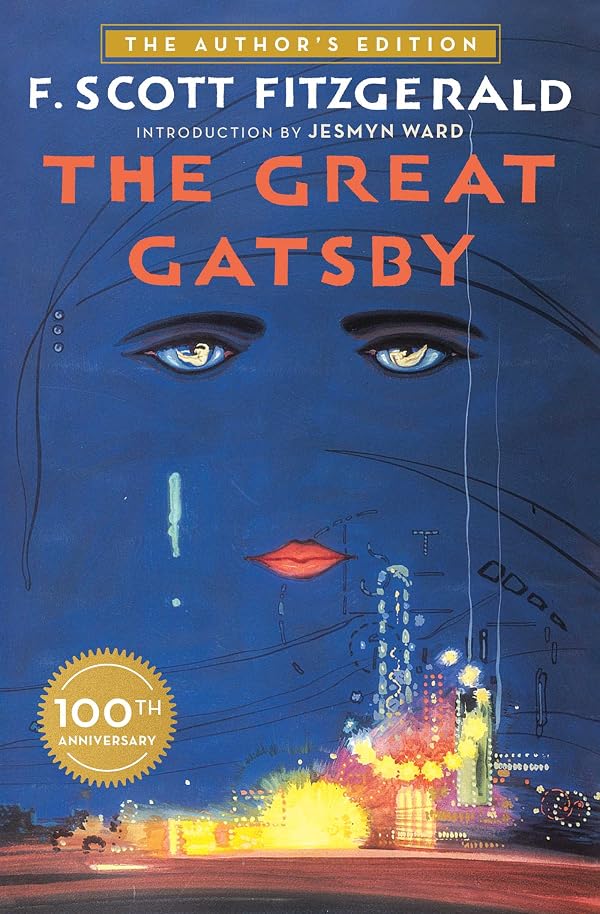
The Great Gatsby
F. Scott Fitzgerald
We may earn a commission on purchases — at no cost to you. As an Amazon Associate we earn from qualifying purchases. Disclosure.
The Great Gatsby is F. Scott Fitzgerald's slender masterpiece about Jay Gatsby, a mysterious millionaire who throws lavish parties on Long Island in a single-minded quest to win back the woman he loved and lost. Narrated by Gatsby's neighbour Nick Carraway, the novel dissects the glittering surface of the Jazz Age to expose the emptiness and cruelty beneath the American Dream. It endures as the definitive portrait of yearning, illusion, and the impossibility of repeating the past.
- 1Nick Carraway, a young bond salesman newly arrived on Long Island, narrates the story of his enigmatic neighbour Jay Gatsby.
- 2Gatsby throws extravagant parties in the hope of drawing back Daisy Buchanan, his lost love, now married to the wealthy, brutish Tom.
- 3Gatsby built his entire fortune and persona, reinventing himself from poor farm boy James Gatz, for the sole purpose of winning Daisy.
- 4The green light at the end of Daisy's dock is the novel's central symbol of Gatsby's unreachable longing.
- 5Daisy, driving Gatsby's car, kills Tom's mistress Myrtle Wilson in a hit-and-run, and lets Gatsby take the blame.
- 6Myrtle's husband, misled by Tom, shoots Gatsby dead in his pool, and almost no one attends the funeral of the man whose parties everyone had flocked to.
Key ideas
The corrupted American Dream
Gatsby embodies the dream of self-invention, rising from poverty to fabulous wealth, but Fitzgerald shows the dream hollowed out and corrupted. Gatsby's fortune comes from bootlegging and crime, and his goal, winning Daisy, reduces the promise of American possibility to the pursuit of a woman who represents status. The novel is an elegy for an ideal already spoiled.
The green light and unreachable longing
The green light burning at the end of Daisy's dock, which Gatsby reaches toward in the dark, is one of literature's most famous symbols. It stands for the dream always just out of grasp, the future we strain toward and never reach. Fitzgerald ties it to the human tendency to be borne back ceaselessly into the past.
The impossibility of repeating the past
Gatsby's fatal conviction is that he can recreate what he had with Daisy five years earlier, insisting to Nick that of course the past can be repeated. His refusal to accept that Daisy has changed, married and moved on drives the tragedy. Fitzgerald presents this as both magnificent and doomed.
Careless people and class cruelty
Tom and Daisy Buchanan are, in Nick's judgement, careless people who smash things and creatures and retreat into their money, leaving others to clean up. Their casual cruelty, letting Gatsby die for Daisy's crime and feeling no remorse, exposes the moral rot beneath old wealth. The novel indicts a class that consumes people and discards them.
Nick as flawed witness
Nick claims to be one of the few honest people he knows, yet his account is coloured by his growing admiration for Gatsby and disgust with the Buchanans. Fitzgerald makes him both our guide and a participant whose judgements shape everything, so the reader must weigh his reliability. His final verdict elevates Gatsby even as it condemns the world that destroyed him.
The valley of ashes
Between the wealthy enclaves and Manhattan lies the valley of ashes, a grey industrial wasteland overseen by the faded eyes of Doctor T.J. Eckleburg on a billboard. It represents the moral and social decay underlying the era's prosperity, and the human cost, embodied by the Wilsons, on which the glamour rests.
Notable quotes
“So we beat on, boats against the current, borne back ceaselessly into the past.”
— closing line
Who is it for?
Readers who want a short, perfectly crafted novel that rewards endless rereading will find Gatsby essential, its prose as dazzling as the parties it describes. It suits anyone interested in the American Dream, the Jazz Age, or the anatomy of longing and illusion. It is a cornerstone of American literature that newcomers and returning readers alike find richer each time.
Full summary
Nick Carraway, a young Midwesterner, moves to the West Egg district of Long Island in the summer of 1922 to work in the bond business. He rents a modest house next door to the enormous mansion of Jay Gatsby, a mysterious millionaire famous for the spectacular parties he throws every weekend.
Nick reconnects with his cousin Daisy Buchanan and her husband Tom, who live across the bay in fashionable East Egg. Tom is having an affair with Myrtle Wilson, the wife of a garage owner in the desolate valley of ashes between Long Island and the city, and he makes little effort to hide it.
Nick attends one of Gatsby's parties and finally meets his host, discovering a man of immense wealth but obscure origins, around whom wild rumours swirl. Gatsby cultivates Nick, and it emerges that his interest has a purpose: Daisy is the woman Gatsby loved years earlier, before the war and before her marriage.
Gatsby reveals that everything, the fortune, the mansion, the parties, was built to draw Daisy back to him. He asks Nick to arrange a reunion, and when the two former lovers meet again, the old feeling reignites. Gatsby is triumphant, convinced he can erase the intervening years and reclaim the past exactly as it was.
The affair between Gatsby and Daisy grows bolder, and tension builds toward a confrontation. On a sweltering day in Manhattan, Tom exposes Gatsby's criminal means of making money and mocks his pretensions, and Daisy, forced to choose, cannot bring herself to say she never loved Tom.
Driving back to Long Island in Gatsby's car, with Daisy at the wheel, they strike and kill Myrtle Wilson, who had run into the road. Daisy does not stop. Gatsby, protecting her, resolves to take the blame for the death, still believing in a future with her.
Tom tells Myrtle's grieving husband George that the car belonged to Gatsby, implying Gatsby was both driver and Myrtle's lover. George, deranged with grief, goes to Gatsby's mansion, shoots him dead in his swimming pool, and then kills himself.
Almost no one comes to Gatsby's funeral, though hundreds had thronged his parties. Disillusioned with the careless, cruel world of the East, Nick returns to the Midwest, reflecting on Gatsby's doomed, magnificent capacity for hope and on the receding dream that always lies just beyond reach.