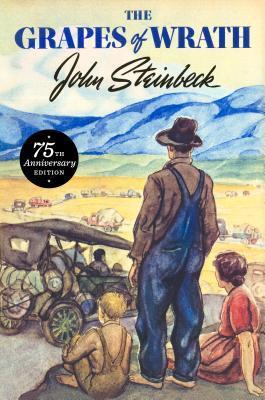
The Grapes of Wrath
John Steinbeck
We may earn a commission on purchases — at no cost to you. As an Amazon Associate we earn from qualifying purchases. Disclosure.
The Grapes of Wrath is John Steinbeck's monumental novel about the Joad family, displaced tenant farmers from Oklahoma during the Great Depression and the Dust Bowl, who migrate to California in search of work and dignity, only to find exploitation, racism and poverty in the fields. Through the Joads' journey, Steinbeck chronicles the plight of migrant workers and suggests that the only path to human dignity is through collective action and solidarity. It is a novel of rage, compassion and the enduring human capacity for hope despite systematic injustice.
- 1The Joad family is displaced from their Oklahoma farm when the bank forecloses, and they join thousands of others heading to California in search of work.
- 2Pa Joad represents the older generation's attachment to the land and traditional ways, while Tom Joad's politicisation represents a new consciousness of injustice.
- 3Ma Joad is the emotional centre of the family, holding them together through hardship with wisdom and determination.
- 4In California, the Joads find that there are far more workers than jobs, and that agricultural companies deliberately maintain poverty wages by keeping workers desperate and competing.
- 5Tom Joad becomes politicised by witnessing injustice and begins to understand that individual survival is impossible without collective resistance.
- 6The novel ends with an act of human charity that suggests that solidarity and compassion are humanity's best response to systematic injustice.
Key ideas
The Dust Bowl as apocalypse
Steinbeck renders the environmental catastrophe of the Dust Bowl as a biblical plague, a natural disaster that destroys the economic foundation of farmers' lives. The displacement is economic, environmental and spiritual.
Exploitation as system
The novel shows that agricultural companies deliberately maintain low wages and poor conditions by ensuring constant oversupply of labour. Exploitation is not individual cruelty but systematic policy designed to maximise profit.
The politicisation of Tom Joad
Tom's journey from individual survival to political consciousness is the novel's emotional arc. Steinbeck suggests that witnessing injustice forces consciousness and demands action.
Ma Joad's moral authority
Ma Joad is the character most alive to the humanity of others, and she becomes the moral compass of the family. Steinbeck treats maternal wisdom and compassion as profound moral forces.
Collective action as necessity
Tom's final understanding is that individual survival is impossible when systems are unjust. Only collective action and solidarity can change the conditions of labour and create dignity.
The land as home and loss
The land is not just an economic resource but a spiritual home. Losing it is losing identity and connection. Steinbeck grieves the loss of the agrarian world even as he acknowledges the inevitability of industrial capitalism.
Who is it for?
Readers who want a foundational American novel about class struggle and social injustice will find this essential and powerful. It suits anyone interested in American history, labour activism or the plight of migrant workers. Readers of The Jungle or Beloved will appreciate Steinbeck's moral clarity and his refusal to turn away from suffering.
Full summary
The Joad family are tenant farmers in Oklahoma during the Great Depression. When the Dust Bowl hits and banks foreclose on farms, the Joads are forced to leave the land that has been their home and their source of identity.
Prompted by handbills promising work in California, they join thousands of other displaced farmers in a mass migration west, hoping to find agricultural work and rebuild their lives.
The journey is difficult and shows the humanity of the Joads but also the inhumanity of the systems arrayed against them. They face discrimination, exploitation and the constant threat of starvation.
In California, they discover that the promise of work was a lie designed to attract desperate workers. There are far more labourers than jobs, and agricultural companies maintain this oversupply deliberately to keep wages low.
Pa Joad struggles with the loss of his role as provider and patriarch. Tom Joad, the novel's moral centre, gradually becomes politicised by witnessing the systematic exploitation of workers and the indifference of the companies and government to their suffering.
Ma Joad becomes the emotional anchor of the family, holding them together and embodying compassion and wisdom even as circumstances strip away everything they own.
Through the novel, the Joads encounter other workers and begin to understand that their individual struggles are part of a larger struggle. Strikes and organising efforts represent the only path to change.
The novel builds toward its ending with the Joads in a barn during a flood. In a final act of human charity, Rose of Sharon, one of the Joad daughters, offers her breast to a starving man, a gesture that suggests that solidarity and compassion are humanity's best response to injustice.