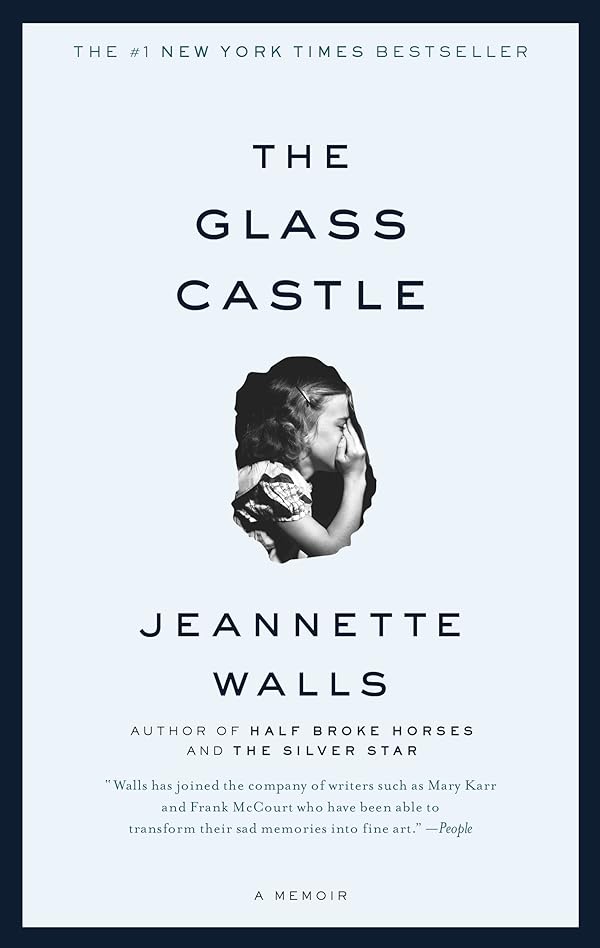
The Glass Castle
Jeannette Walls
We may earn a commission on purchases — at no cost to you. As an Amazon Associate we earn from qualifying purchases. Disclosure.
The Glass Castle is Jeannette Walls's memoir of being raised by parents who treated poverty, hunger and homelessness as an adventure they had chosen. Her father Rex was a brilliant, charismatic alcoholic who promised to build the family a house of glass and never poured a foundation, and her mother Rose Mary was a painter who described herself as an excitement addict and refused to take a teaching job she was qualified for. Walls tells it without self-pity or score-settling, which is what makes it devastating rather than merely sad.
- 1Walls's earliest memory is catching fire at age three while boiling hot dogs alone on a stove, and being pulled from the hospital by her father before the treatment was finished.
- 2The family moved constantly through the Southwest doing what Rex called the skedaddle, leaving towns overnight ahead of bills and bill collectors.
- 3Rex was an engineer and self-taught physicist who could teach his children Morse code and geology but drank away whatever money reached the house.
- 4Rose Mary owned land in Texas worth around a million dollars and a teaching credential, and used neither while her children ate margarine and searched school bins for food.
- 5The children saved money in a piggy bank to escape Welch, West Virginia, and their father split it open and spent it.
- 6Lori, Jeannette and Brian each escaped to New York in turn, where Jeannette eventually became a Manhattan gossip columnist, while their parents followed and chose to live as squatters.
Key ideas
The house that was never built
Rex carried blueprints for the Glass Castle everywhere, a solar-powered home of glass and steel that he refined for years. The children helped dig the foundation hole in Welch, and it filled up with the family's garbage because there was nowhere else to put it. Walls lets that image do the work without commenting on it.
A childhood presented as an adventure
Rex teaches the kids to swim by repeatedly throwing Jeannette into the sulphur springs, gives each child a star for Christmas because there is no money for presents, and calls hunger a chance to build character. Rose Mary tells her daughter that suffering builds an artist. The memoir's tension comes from a child who genuinely believed this and an adult narrator who no longer does.
Welch, and the point where it stops being funny
The move to Rex's home town in West Virginia takes the family from precarious to desperate: a house on Little Hobart Street with no plumbing, a leaking roof, a bucket for a toilet and a ceiling that collapses. Jeannette digs through the school rubbish bin at lunch and hides in a bathroom stall to eat. Brian and Jeannette also confront Erma, their grandmother, when she molests Brian.
Rose Mary's refusals
The most disturbing figure in the book is arguably not the alcoholic father but the mother who had options. She holds a teaching qualification, works only when forced, hides chocolate under a blanket while the children starve, and later reveals she owns Texas land worth a fortune. Asked why she does not sell it, she talks about sentimental value.
Escape as a plan, not an accident
The children pool money in a plastic piggy bank called Oz, and when Rex steals it they simply start again. Lori goes to New York first, Jeannette follows at seventeen and finishes school while working, and Brian comes after. Their sister Maureen, raised largely by neighbours and the least protected of the four, does not recover in the same way.
Love that refuses to resolve
Walls does not renounce her parents. Rex tracks down money for her college tuition, and she chooses to remember him teaching her physics as much as stealing from her. The memoir opens with her, in a taxi in designer clothes, seeing her mother digging through a dumpster and ducking below the window, and the entire book is an answer to that flinch.
Notable quotes
“you'll still have your stars”
— Rex, giving the children planets for Christmas
Who is it for?
Readers who want a memoir with genuine narrative propulsion, not just hardship, will find this hard to put down, and Walls's refusal to editorialise makes it far more powerful than an angrier book would be. It is a standing book club favourite because people argue fiercely about whether the parents deserve forgiveness. Anyone who valued Educated, Hillbilly Elegy or Angela's Ashes should read this one first.
Full summary
The memoir opens in the present: Walls is in a taxi in New York, dressed for a party, when she sees her mother going through a dumpster on the street. She ducks down and asks the driver to keep going, then goes home and starts writing about where she came from.
Her first memory is being three years old in a trailer in Arizona, cooking hot dogs on the stove because nobody else would, and catching fire. She spends six weeks in hospital and her father discharges her by carrying her out without paying, which he calls checking out Rex Walls style.
The family moves constantly through Nevada, Arizona and California, packing in minutes when creditors or landlords close in. Rex teaches the children constellations, geology and how to spot flaws in an argument. Rose Mary paints. There is sometimes no food for days, and the children learn not to mention it.
In Battle Mountain and later Phoenix, patterns harden. Rex disappears on benders and returns with nothing. Rose Mary inherits a house and the family lives in it briefly before losing that too. Jeannette confronts her mother about a job and is told that an artist cannot be expected to do something so ordinary.
The family moves to Welch, West Virginia, to live with Rex's parents. His mother Erma is cruel and, it emerges, abusive toward Brian. The children move into 93 Little Hobart Street, a house with no heating, no working plumbing and a roof that leaks onto their beds. Jeannette starts scavenging food at school.
Rex takes Jeannette to a bar and lets a man grope her while he plays pool, having promised her it will help him win money back. It is the moment the book's account of him changes. The children begin saving in earnest and he takes their money for drink.
Lori leaves for New York at seventeen. Jeannette follows the next summer, finishes high school, and works her way through Barnard. Brian arrives after. The three build ordinary lives, and their parents move to New York too, living in a squat by choice and refusing every offer of an apartment.
Rex dies of a heart attack in 1994 after telling Jeannette he has always been proud of her. Maureen, the youngest, stabs their mother during an argument and is institutionalised, then leaves for California and does not stay in touch. The book closes at a Thanksgiving table where the surviving siblings raise a glass to their father.