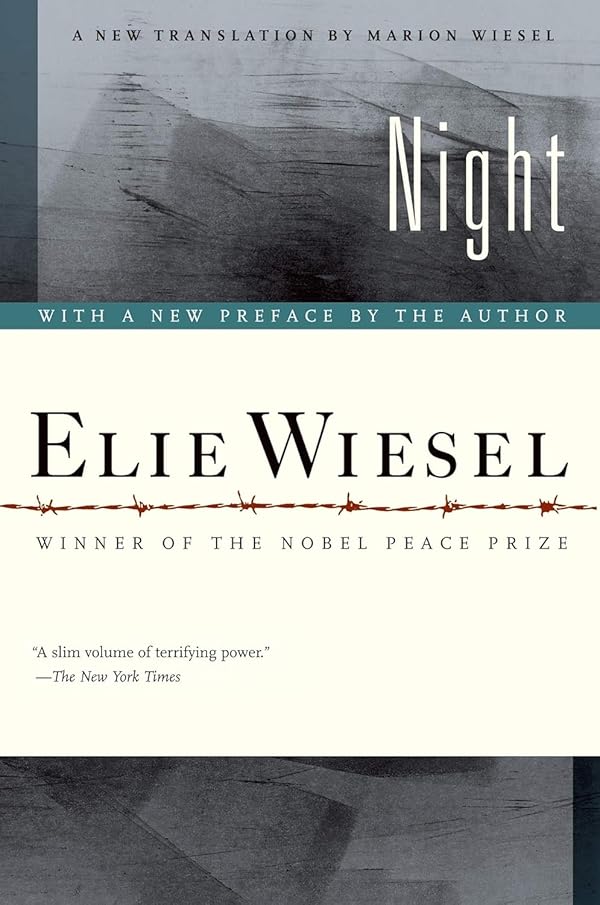
Night
Elie Wiesel
We may earn a commission on purchases — at no cost to you. As an Amazon Associate we earn from qualifying purchases. Disclosure.
Night is Elie Wiesel's Holocaust memoir about his experiences as a teenager imprisoned in Nazi concentration camps. The novel is a powerful and devastating account of survival and the endurance of faith and identity amid unimaginable horror.
- 1Wiesel is a Jewish teenager deported to concentration camps with his family.
- 2He experiences the horrors of the camps, including starvation, disease and violence.
- 3His father is imprisoned with him, and their relationship is central to his survival.
- 4Wiesel's experience in the camps shakes his faith and tests his humanity.
- 5He survives the camps but carries the trauma for the rest of his life.
- 6The memoir is a testimony to the Holocaust and to human resilience.
Key ideas
Survival and witness
Wiesel survives to bear witness to the Holocaust and to those who did not survive.
Faith and doubt
Wiesel's experience in the camps challenges and transforms his religious faith.
Human dignity and degradation
The camps attempt to degrade prisoners, but Wiesel maintains core elements of dignity.
Father-son bond
The relationship between Wiesel and his father is central to his survival.
The power of testimony
Telling his story is Wiesel's way of honouring the dead and bearing witness.
The impossibility of forgetting
Wiesel insists that the Holocaust must be remembered and never forgotten.
Who is it for?
Readers interested in Holocaust memoirs and in understanding this historical tragedy will find this essential and devastating. It suits anyone interested in bearing witness to history and in how survivors maintain humanity amid inhumanity.
Full summary
Wiesel is a Jewish teenager living in Hungary when the Nazis begin deporting Jews.
He and his family are deported to Auschwitz concentration camp.
Wiesel's mother and younger sister are killed immediately upon arrival.
Wiesel and his father are forced to work and to survive the horrors of the camp.
Wiesel experiences starvation, disease, violence and the dehumanisation of the camps.
He witnesses the death of countless prisoners and struggles to maintain his humanity.
His father's illness and death affect him deeply.
Wiesel survives and is liberated but carries the trauma and memory of the camps forever.