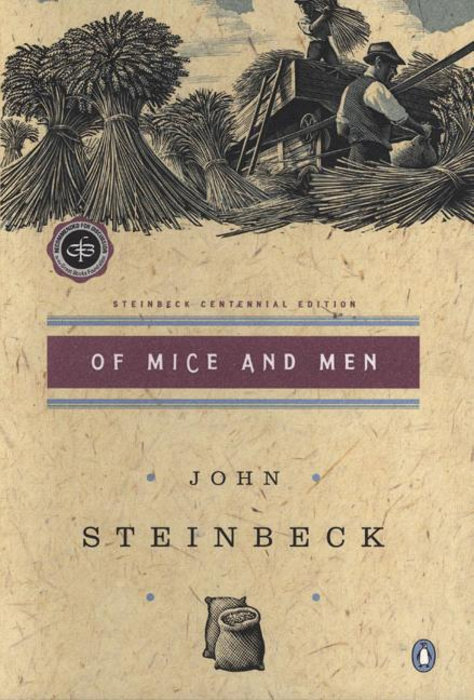
Of Mice and Men
John Steinbeck
We may earn a commission on purchases — at no cost to you. As an Amazon Associate we earn from qualifying purchases. Disclosure.
Of Mice and Men is John Steinbeck's novella about George Milton and Lennie Small, two migrant workers during the Great Depression who travel together looking for work on California farms, sharing the dream of owning their own plot of land. Lennie, a man with intellectual disability, depends entirely on George, who must protect him from a world that views him as dangerous and useless. It is a tragedy about friendship, disability, and the impossibility of escape from circumstance, told with Steinbeck's spare, powerful prose.
- 1George and Lennie are migrant farm workers who dream of owning their own land, a dream they believe will liberate them from the precariousness of migrant labour.
- 2Lennie has an intellectual disability and is childlike in his thinking, dependent on George for protection and guidance in a world that frightens and confuses him.
- 3George is burdened by his responsibility for Lennie but is also bound to him by love and loyalty. He carries the weight of Lennie's safety and Lennie's future.
- 4The novella is set on a California ranch where they seek work, and the other workers present obstacles to their dream and threats to Lennie's safety.
- 5Lennie's childlike nature and his strength without understanding lead him into situations where he inadvertently causes harm, threatening both of their futures.
- 6The novella builds toward a tragic climax where the impossible nature of their dream becomes clear.
Key ideas
The impossibility of the dream
George and Lennie's dream of owning land and being free is portrayed as impossible given the economic realities of the Depression era. Dreams of escape are fragile and easily destroyed.
Disability and vulnerability
Steinbeck portrays Lennie's intellectual disability with empathy and realism. Lennie is not an object of pity but a person with genuine love and desire who is made vulnerable by his limitation.
Friendship as burden and grace
George's care for Lennie is portrayed as both burden and grace. Love and loyalty bind him to a responsibility he did not choose, yet the bond between them is genuine and transformative.
Cruelty and indifference
The world Steinbeck depicts is cruel and indifferent to those who do not fit or who are vulnerable. Curley and his wife represent a world that uses cruelty as a tool of power.
Agency and powerlessness
Despite their efforts, George and Lennie have little agency over their own fates. They are subject to economic forces and social prejudices that limit their possibilities.
Mercy as love
The novella's ending suggests that sometimes the most loving act is to intervene to prevent greater suffering. Steinbeck treats this with profound moral complexity.
Who is it for?
Readers who want a perfectly crafted novella about friendship and human vulnerability will find this essential and devastating. It suits anyone interested in Depression-era America, disability representation or the American Dream's failure to include everyone. Readers of The Grapes of Wrath will appreciate Steinbeck's compassion and critique.
Full summary
George Milton and Lennie Small are migrant workers travelling together during the Great Depression. Lennie has an intellectual disability and George has taken responsibility for his care and protection.
Despite their precarious circumstances, George and Lennie share a dream: to own a small plot of land, to raise rabbits, and to be free from the dependence and danger of migrant labour.
They find work on a California ranch, hopeful that they can earn enough to begin saving for their dream. The other workers on the ranch are cruel and indifferent, seeing Lennie as strange and dangerous.
Lennie's childlike nature and his inability to understand consequences create constant danger. He loves soft things but does not understand his own strength, and he often does things that terrify and endanger George.
Curley, the boss's son, is aggressive and uses violence to assert dominance. Lennie is particularly threatening to him because Lennie's strength and naivety make him unpredictable.
Lennie's interaction with Curley's wife, a lonely woman seeking attention, leads to an accident that is beyond undoing. The consequences cascade, forcing George and Lennie to confront the impossibility of their dream.
George must decide what mercy and love require in an impossible situation. The novella builds toward a tragic climax where George must choose between abandoning Lennie and protecting him in the only way left available.
Steinbeck closes the novella with a meditation on friendship, loss and the fragility of human dreams in a world that is indifferent to hope.