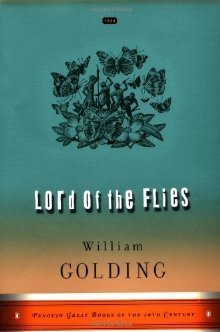
Lord of the Flies
William Golding
We may earn a commission on purchases — at no cost to you. As an Amazon Associate we earn from qualifying purchases. Disclosure.
Lord of the Flies is William Golding's masterpiece about a group of boys stranded on an uninhabited island after a plane crash who attempt to govern themselves, but whose civilisation gradually collapses into savagery and violence. Through the boys' descent, Golding explores the fragility of civilisation, the darkness inherent in human nature and how easily societal structures can crumble when external constraints are removed. It is a meditation on human nature, power and the beast within.
- 1A plane crashes and a group of boys, ranging in age from about six to twelve, are stranded on an uninhabited island without adults.
- 2Ralph, an older boy, becomes the elected leader and attempts to establish rules, including the maintenance of a signal fire.
- 3Jack, another older boy, leads a group of hunters and gradually challenges Ralph's authority, offering the boys freedom and the thrill of the hunt.
- 4As the boys' time on the island continues, the divisions between those following Ralph and those following Jack deepen.
- 5The boys begin to believe in a 'beast' on the island and use this imagined threat to control each other through fear.
- 6The novel builds toward a climax where civilisation completely breaks down and violence becomes the governing principle.
Key ideas
The fragility of civilisation
Golding's central insight is that civilisation is thin and fragile, dependent on shared agreement and external enforcement. Remove adults and rules, and savagery emerges quickly.
The appeal of savagery
The novel suggests that savagery and violence are seductive. Jack's offer of freedom and the thrill of hunting appeals to the boys' deepest instincts more than Ralph's rational governance.
Power and leadership
Ralph's leadership is democratic but weak, while Jack's is authoritarian and compelling. Golding explores how charisma and the promise of excitement can override rational choice.
The beast as psychological projection
The boys' fear of the beast is really fear of their own capacity for violence and savagery. The beast is both external threat and internal reality.
The corruption of innocence
Even young boys are capable of cruelty and violence. Golding refuses the idea that children are innocently good, suggesting instead that evil is inherent in human nature.
Ritual and tribalism
The boys gradually develop tribal rituals and hierarchies, suggesting that tribalism is a natural human tendency even for the young.
Who is it for?
Readers who want to understand a foundational novel of English literature will find this essential. It suits anyone interested in how civilisation functions or in the dark side of human nature. Teachers use it as a staple of education, but it rewards reading by adults as well. Readers of The Hunger Games or dystopian fiction will recognise its influence.
Full summary
A plane carrying a group of boys crashes on an uninhabited tropical island. The boys range in age from about six to twelve, and there are no adults present.
Ralph, an older boy, and Jack, another leader figure, attempt to organise the boys. Ralph is elected chief and proposes that they maintain a signal fire to attract rescue while establishing basic rules and order.
Jack takes on the role of hunter, leading a group of boys to hunt for food. The hunt becomes increasingly important to Jack, and the boys in his group become devoted to him.
As time passes, Jack and Ralph's visions for the island diverge sharply. Ralph prioritises rescue and governance; Jack prioritises hunting and power.
The boys develop fear of a 'beast' on the island, an imagined predator that may not exist but serves to control them through fear.
Jack's group breaks away and establishes a separate camp, and the division becomes irreversible. Jack's tribe offers the boys freedom from Ralph's rules and the excitement of the hunt.
The boys gradually abandon civility. They develop rituals, especially a hunting chant, that bring them together but also strip away inhibition and rationality.
Violence erupts, and a boy is killed in the chaos. Ralph's group becomes increasingly isolated and hunted. The novel builds toward a climax where all restraint is lost and the boys descend into savagery.