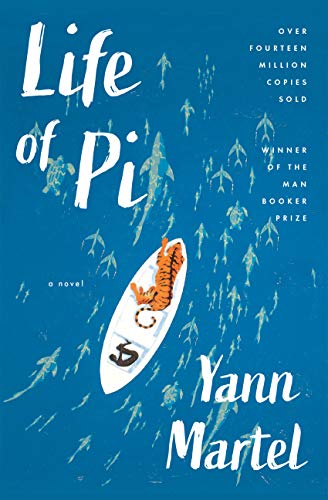
Life of Pi
Yann Martel
We may earn a commission on purchases — at no cost to you. As an Amazon Associate we earn from qualifying purchases. Disclosure.
Life of Pi is Yann Martel's novel about Piscine Molitor Patel, an Indian boy who survives 227 days adrift in the Pacific in a lifeboat with a Bengal tiger named Richard Parker. Framed as a story that will make you believe in God, it is really an argument about storytelling itself: at the end Pi offers a second, brutal version of events without animals and asks which one you prefer. Martel uses a survival adventure to ask whether the truth of a story lies in its facts or in the meaning we choose to give them.
- 1Pi grows up in Pondicherry, where his father runs a zoo, and simultaneously practises Hinduism, Christianity and Islam, refusing to choose between them.
- 2The family emigrates to Canada with their animals aboard a Japanese cargo ship, the Tsimtsum, which sinks in a storm.
- 3Pi survives in a lifeboat with a zebra, an orangutan, a hyena and a Bengal tiger; the hyena kills the others until only Pi and the tiger remain.
- 4Pi survives by feeding and managing the tiger, establishing dominance and routine so that Richard Parker's presence keeps him alert and alive rather than killing him.
- 5After 227 days they reach Mexico, where Richard Parker walks into the jungle without a backward glance, which wounds Pi more than anything else.
- 6Interviewed by insurance investigators who disbelieve the animals, Pi tells a second story in which the animals are people, and asks which version they prefer to believe.
Key ideas
The two stories and the reader's choice
When the Japanese investigators reject the tale of the tiger, Pi retells the voyage with humans: the zebra is a sailor, the orangutan his mother, the hyena a vicious cook, and the tiger is Pi himself. The facts are identical and equally unprovable. Pi points out that neither story explains the sinking, so the investigators may as well choose the better one, and Martel hands the same choice to the reader.
Faith held in the plural
As a boy Pi is a devout Hindu who is also baptised Christian and also practises Islam, and when the three religious leaders meet and demand he pick one, he refuses. His argument is that he just wants to love God, and the multiplicity is the point. This religious openness is the ground the whole novel is built on.
Richard Parker as the will to survive
The tiger, named through a clerical error after the hunter who caught him, is a real animal and also, in the second story, Pi's own capacity for violence. Managing him, feeding him, never turning his back on him, is what forces Pi to stay disciplined and alert for eight months. Pi says outright that without Richard Parker he would have died of despair.
The zoo and the truth about wildness
The early chapters, which some readers find slow, are load-bearing. Pi's father teaches him that a zoo animal is not free but safe, and that the most dangerous animal is the one you have sentimentalised. That lesson in how to survive alongside a predator is exactly what keeps Pi alive later, and it quietly undercuts romantic ideas about nature.
The carnivorous island
Midway through the ordeal Pi lands on a floating island of algae teeming with meerkats, which nourishes by day and turns acidic and lethal by night, dissolving anything that stays. He finds human teeth inside a fruit and flees. The episode is the novel's strangest, a test of the reader's willingness to accept a story that cannot be literally true.
Which story is about God
The frame narrator was promised a story that would make him believe in God. Martel's suggestion is that choosing the version with the tiger, the more beautiful and less provable one, is itself the religious act, a decision to prefer meaning over bare fact. Faith, in this reading, is a choice about which story to live inside.
Who is it for?
Readers who enjoy a gripping survival adventure that also works as a philosophical puzzle will get the best of both here, and the final twist tends to send people straight back to the beginning. It suits anyone interested in faith, storytelling, or the boundary between them, and it makes for exceptional book club argument. Readers who loved The Alchemist or Cloud Atlas will appreciate its blend of story and idea.
Full summary
A novelist, told that Pi Patel has a story that will make him believe in God, seeks him out in Canada, and Pi begins at the beginning, in Pondicherry, where his father ran the local zoo and Pi grew up understanding animals as creatures of habit and territory rather than sentiment.
Named Piscine after a Paris swimming pool and teased as Pissing, the boy renames himself Pi. As a teenager he is drawn to religion with unusual intensity, becoming a practising Hindu, Christian and Muslim at once, and refusing to give any of them up when confronted by their respective clergy.
Political and economic pressures lead the family to sell the zoo and emigrate to Canada, shipping the animals with them aboard a Japanese freighter. In the middle of the Pacific, the ship sinks in a night storm. Pi is thrown into a lifeboat and the ship goes down with his family aboard.
He finds himself sharing the boat with a wounded zebra, a hyena, and an orangutan named Orange Juice who floated over on a raft of bananas. The hyena kills the zebra and the orangutan. Then a full-grown Bengal tiger, Richard Parker, who had been hidden under the tarpaulin, emerges and kills the hyena.
Alone with a tiger, Pi draws on everything his father taught him. He builds a small raft tethered to the boat, establishes a feeding routine, uses a whistle and the boat's motion to assert dominance, and comes to understand that keeping Richard Parker alive is what keeps himself alive, giving each day a purpose.
The voyage becomes a catalogue of survival: catching fish and turtles, collecting rainwater, going temporarily blind, and a hallucinatory encounter with another blinded castaway. They come upon a floating island of algae and meerkats that feeds them by day and turns deadly acidic at night, and Pi realises he must leave it or die there.
After 227 days the boat washes onto a Mexican beach. Richard Parker bounds across the sand and disappears into the jungle without pausing to acknowledge Pi, who weeps at the abruptness of it, having wanted some closing recognition from the companion who saved him.
Recovering in hospital, Pi is interviewed by two officials from the shipping company who cannot accept the story. He offers a second account in which the animals were people and the violence was human, then observes that since neither version can be checked and neither explains why the ship sank, the choice between them is theirs. They file their report citing the story with the tiger.