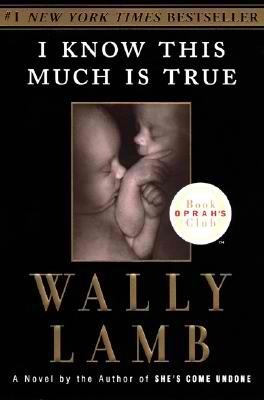
I Know This Much Is True
Wally Lamb
We may earn a commission on purchases — at no cost to you. As an Amazon Associate we earn from qualifying purchases. Disclosure.
I Know This Much Is True is Wally Lamb's sweeping novel told through the voice of Mark Shalvoy, a middle-aged man navigating the aftermath of his identical twin brother Dominick's schizophrenic breakdown, which included the public self-mutilation that leaves him institutionalised. As Mark struggles to secure proper care for his brother, he is forced to excavate the family history that shaped them both: their adoptions, their mother's lies and secrets, and the cycle of trauma and love that binds them. It is a novel about family obligation, mental illness and the ways that trauma echoes through generations.
- 1Mark and Dominick Shalvoy are identical twins adopted by a working-class Italian-American couple, their origins hidden from them throughout their childhood.
- 2Dominick suffers from untreated mental illness, and his violent breakdown, a public act of self-mutilation, forces him into institutionalisation.
- 3Mark, a marriage counsellor, must become Dominick's guardian and advocate while managing his own marriage, which is falling apart under the strain.
- 4The novel alternates between the present crisis and Mark's excavation of family history, revealing secrets about the twins' adoption and their parents' lives.
- 5Their adoptive mother's lies and denial about Dominick's mental illness set the stage for his later crisis, and Mark must confront how family dysfunction has shaped his own life.
- 6Mark's journey is ultimately about understanding that love and obligation to family are inseparable, even when family has caused profound hurt.
Key ideas
Mental illness and family denial
Dominick's schizophrenia is visible for years before his breakdown, but family denial and lack of resources prevent proper treatment. Lamb explores how mental illness is often hidden or minimised, and how that hiding perpetuates suffering.
The weight of obligation
Mark is bound to Dominick by biology and love, yet Dominick's needs threaten to consume Mark's own life. Lamb explores the question of what we owe to those we love and how obligation can be both sacred and suffocating.
Adoption and identity
Mark and Dominick's discovery that they are adopted reframes their entire identities. Lamb explores how origin stories shape identity and how secrets about identity create fractures in family relationships.
The cycle of trauma
As Mark excavates family history, he discovers that trauma cycles through generations: their adoptive parents were shaped by Depression-era hardship and their own losses, which shaped how they parented.
Masculine identity and caregiving
Mark, defined by his role as the strong one, is forced into the role of caregiver. Lamb explores how caregiving challenges traditional masculine identity and forces vulnerability.
The complexity of love
The novel suggests that love for family is not simple or uncomplicated. Love can include anger, resentment and obligation, and it is complicated further by mental illness and trauma.
Who is it for?
Readers who want a deeply human novel about family obligation and mental illness will find this emotionally powerful and psychologically complex. It suits anyone who has loved someone with mental illness, or anyone interested in how family histories shape individual destinies. Readers of The House of the Spirits or One Hundred Years of Solitude will appreciate the multigenerational scope.
Full summary
Mark Shalvoy is a marriage counsellor living a middle-class life when his identical twin brother Dominick suffers a catastrophic breakdown involving self-mutilation and is institutionalised for mental illness.
As Dominick's brother and closest relative, Mark becomes responsible for navigating the mental health system and securing appropriate care, a burden that falls entirely on him when other family members step back.
The novel alternates between Mark's present struggle to advocate for Dominick and his excavation of family history, prompted by his attempt to understand how his brother's illness developed.
Mark discovers that he and Dominick were adopted, a secret kept from them throughout their childhood. Their adoptive parents, Ma and Pa, were working-class Italian-Americans shaped by Depression-era struggles and their own losses.
As Mark digs deeper, he learns that Dominick's mental illness was visible for years, his behaviour disturbing, his reasoning distorted, but family denial and lack of resources prevented intervention. Ma, in particular, refused to acknowledge or seek treatment for her son's condition.
Mark's marriage to his wife Dessa strains under the weight of caring for Dominick. Mark is consumed by guilt and obligation, while Dessa resents the incursion of Dominick's needs into their lives. The marriage becomes a casualty of Mark's loyalty to his brother.
Through therapy and research, Mark begins to understand that trauma cycles: his adoptive parents were marked by their own losses and historical circumstances, which shaped how they parented. They gave their sons love but also denial and inadequacy.
The novel builds toward Mark's understanding that his obligation to Dominick is real but that he must also care for himself. The ending suggests that love and obligation are inseparable, but that boundaries must exist. Mark learns to hold both his love for his brother and his recognition that some wounds cannot be healed by love alone.