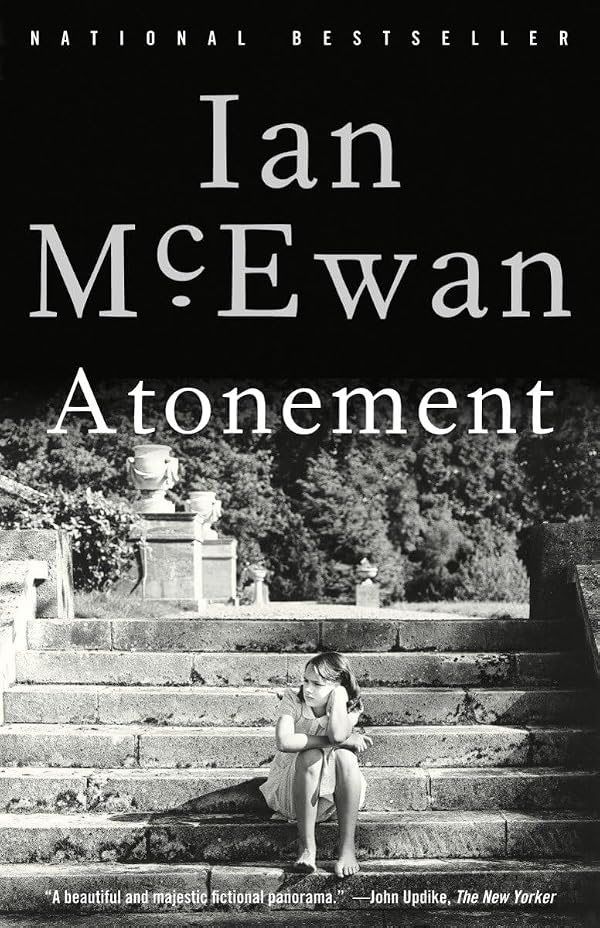
Atonement
Ian McEwan
We may earn a commission on purchases — at no cost to you. As an Amazon Associate we earn from qualifying purchases. Disclosure.
Atonement is Ian McEwan's masterwork about Briony Tallis, a precocious thirteen-year-old girl who misinterprets a charged moment between her sister Cecilia and their neighbour Robbie Turner, accuses Robbie of assault, and sets in motion a catastrophe that reverberates across decades. Spanning from 1935 to the present day, McEwan traces the consequences of a single act of testimony and the possibility, or impossibility, of redemption and forgiveness. It is a novel about the power of narrative, the malleability of truth and the costs of art.
- 1Briony Tallis, an aspiring writer of thirteen, witnesses a sexually charged moment between her sister Cecilia and Robbie Turner, a working-class boy whose education the Tallis family has funded.
- 2Briony misinterprets what she sees and, when her cousin Lola is sexually assaulted later that night, falsely accuses Robbie of the crime.
- 3Robbie is imprisoned based on Briony's testimony, a trauma that defines his young adulthood, while Briony carries the knowledge of her lie.
- 4The novel jumps to Robbie and Cecilia during World War II, and then to the present day, where Briony, now an elderly writer, confronts what she has done.
- 5McEwan plays with narrative reliability and the nature of truth, gradually revealing what actually happened the night of the assault.
- 6The novel asks whether art and fiction can atone for real crimes, and whether forgiveness is possible for those who have caused irreversible harm.
Key ideas
The power of a child's narrative
Briony's testimony, delivered with the authority of a witness, destroys a man's life. McEwan shows how children are not innocent simply because of their age, and how a child's misreading of an event can have devastating adult consequences. Narrative power is not the same as narrative truth.
The unreliable narrator and unreliable memory
McEwan plays with narrative perspective throughout, showing how the same events can be read entirely differently depending on whose view we trust. By the novel's end, readers have learned not to trust any single account of events, and must piece together a more complete truth from fragments.
War as transformation and destruction
Robbie's experience as a soldier in World War II reframes his imprisonment as merely one trauma among many. The war becomes a kind of larger test ground for the themes of the novel: the randomness of suffering, the impossibility of narrative control over events.
Cecilia and Robbie's love across class
The love between Cecilia and Robbie is doomed partly by Briony's lie and partly by the larger forces of class and war. McEwan suggests that individual happiness is always vulnerable to larger social and historical forces beyond our control.
The burden of authorship
Briony becomes a writer, and the novel explores whether writing about something is a form of atonement or a form of self-justification. Can art redeem crime, or does it merely allow the guilty to imagine they have been forgiven?
The ambiguity of ending
McEwan deliberately refuses to provide closure, leaving readers with an ending that seems to undo itself. This refusal to satisfy the reader's desire for narrative resolution mirrors Briony's impossible quest for atonement.
Who is it for?
Readers who love intricate, literary novels that play with narrative structure and ask profound questions about truth and forgiveness will find this rewarding and emotionally devastating. It suits anyone interested in the craft of fiction or in exploring how small actions ripple outward with devastating consequences. Readers of Beloved or The Remains of the Day will appreciate the moral complexity.
Full summary
Briony Tallis, a precocious and imaginative thirteen-year-old girl living on the English estate where her family spends the summer, is obsessed with narrative and storytelling. She writes and performs plays, and she observes the adults around her, fitting their actions into the stories she invents.
She witnesses a charged encounter between her sister Cecilia and Robbie Turner, a young man whose education the Tallis family has paid for. Briony does not fully understand what she sees, but she senses something transgressive in the encounter and feels jealousy at being excluded.
That same night, Briony's young cousin Lola is sexually assaulted by someone in the darkness. Shaken and asked to identify her attacker, Briony, influenced by her earlier observations, names Robbie as the criminal. The accusation is accepted, and Robbie is imprisoned.
The novel shifts forward to 1940, during the height of World War II. Robbie, released from prison years later, is serving as a soldier. He and Cecilia have maintained a love that has survived his imprisonment and her disgrace at home. But the war offers its own traumas and separations.
A section from Robbie's perspective during the war shows the horror of combat and the way historical events overwhelm and destroy individual narrative. Robbie moves through his days as a soldier, his love for Cecilia sustaining him but also making him aware of all that he has lost.
The novel then shifts to a late-twentieth-century perspective, where readers learn that Briony has become a writer and is now elderly. She has written many novels, and in old age begins to reckon with the lie she told as a child.
Briony reflects on whether her life as a writer constitutes atonement for the false accusation that destroyed Robbie's youth and separated him from Cecilia. She considers the novel she has written about these events, which is, in a sense, Atonement itself.
McEwan ends ambiguously, suggesting that atonement through narrative may be a form of self-deception, and that some harms cannot be repaired. Readers are left to consider what actually happened, who is reliable and whether redemption is possible for those who have caused irreversible suffering.