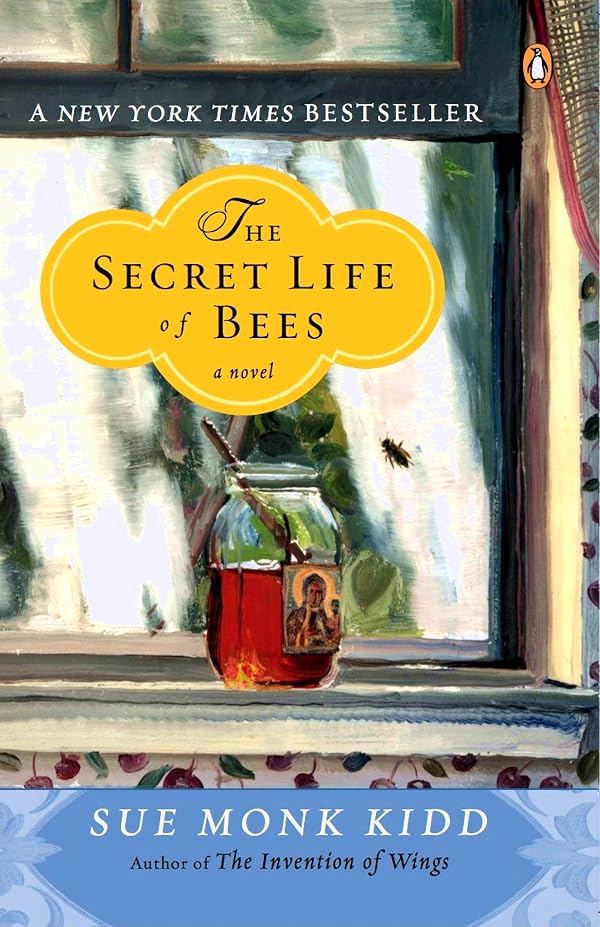
The Secret Life of Bees
Sue Monk Kidd
We may earn a commission on purchases — at no cost to you. As an Amazon Associate we earn from qualifying purchases. Disclosure.
The Secret Life of Bees follows Lily Owens, a fourteen-year-old white girl in 1964 South Carolina who runs away from an abusive father with Rosaleen, the Black woman who raised her, and lands at a honey farm run by three sisters. Sue Monk Kidd sets the story in the summer the Civil Rights Act was signed, and uses beekeeping and a wooden Black Madonna to build a novel about mothers, chosen family and self-forgiveness. Its argument is that a person deprived of a mother has to find one, and that the search rarely ends where it started.
- 1Lily believes she killed her own mother Deborah at age four, having picked up a gun during a fight between her parents.
- 2Her father T. Ray punishes her by making her kneel on uncooked grits, and tells her that her mother had abandoned her before she died.
- 3Rosaleen, Lily's Black caretaker, is beaten and jailed after trying to register to vote, and Lily breaks her out of hospital custody.
- 4A picture of a Black Madonna with the word Tiburon written on the back leads Lily to the Boatwright sisters, August, June and May, who produce Black Madonna Honey.
- 5August knew Lily's mother, having been her housekeeper in Virginia, and eventually confirms that Deborah did leave Lily behind.
- 6May Boatwright, who absorbs the suffering of everyone around her, keeps a wailing wall of prayers and takes her own life after hearing that Zach has been jailed.
Key ideas
Finding a mother rather than recovering one
Lily arrives looking for the woman who left her and finds August Boatwright instead, along with a community of women who mother her without being asked. August's counsel, that the mother has to be found inside yourself, is the book's thesis. The Black Madonna, Our Lady of Chains, functions as the same idea in wood: a mother who belongs to whoever needs her.
The truth about Deborah is not a comfort
Kidd refuses the easy version. August confirms that Deborah did leave Lily with T. Ray, had a breakdown, and came back for her only at the end. Lily has to build a self on a mother who was real and flawed rather than on the idealised version she carried in a bag of relics.
Summer 1964, and what the law did not change
The Civil Rights Act is signed while Rosaleen tries to register to vote, is harassed by three white men, pours snuff juice on their shoes and is beaten for it. Zach, a bright Black teenager who wants to be a lawyer, is jailed for something another boy did. The novel keeps showing legislation arriving well ahead of the town.
The Daughters of Mary and improvised religion
The Boatwrights' worship centres on a ship's figurehead recovered by enslaved people, with its own feast day, honey ritual and congregation of women. Kidd treats it as entirely serious rather than folkloric. It gives Lily something T. Ray's household never offered: a place where she is expected and welcome.
May, and the cost of feeling everything
May cannot filter other people's pain, so she writes griefs on scraps of paper and pushes them into a stone wall. Her twin sister April died young, and May has been unable to seal off anything since. Her death is the novel's hardest turn and the point at which Lily learns that the house she has found is not safe from the world.
The hive as a working metaphor
Each chapter opens with an epigraph from beekeeping manuals about queens, workers and the need for a colony to have a mother. August teaches Lily that bees die without a queen and that you have to tell them your troubles. The metaphor is explicit but Kidd earns it through the practical detail of the work.
Choosing the ending
T. Ray tracks Lily to Tiburon and, in a confrontation where he briefly mistakes her for Deborah, agrees to leave her. Lily stays, and the closing image is of a girl with many mothers rather than none. Kidd deliberately gives her a chosen family instead of a restored one.
Notable quotes
“You have to find a mother inside yourself.”
— August Boatwright
Who is it for?
Readers who love warm, atmospheric coming-of-age fiction with a strong sense of the American South will be at home here, and it is a classic book club novel because of how much there is to discuss about mothers and forgiveness. It suits anyone who wants the civil rights era at a personal, domestic scale rather than through big historical set pieces. If you enjoyed The Help, Where the Crawdads Sing or To Kill a Mockingbird, this belongs on the same shelf.
Full summary
Lily Owens is fourteen, living on a peach farm outside Sylvan, South Carolina, with T. Ray, a father who punishes her by making her kneel on grits. She has one memory of her mother Deborah, who died when Lily was four, and one terrible belief: that the gun that killed her went off in Lily's own hands.
Rosaleen, the Black woman who has raised her since, sets off to register to vote in the weeks after the Civil Rights Act is signed. Three white men in town harass her, she empties her snuff jug on their shoes, and she is beaten and arrested. In the hospital, Lily walks her out and they run.
Lily has kept a few of her mother's things, including a picture of a Black Madonna with Tiburon, South Carolina, written on the back. They hitch there, see the same image on jars of honey in a general store, and are directed to a bright pink house belonging to the Boatwright sisters.
August takes them in without demanding an explanation, though it is clear she suspects one. June, a cellist and teacher, resents the presence of a white girl. May sings Oh Susanna whenever she is upset and keeps a wall of written griefs at the bottom of the garden.
Lily learns beekeeping: how to work without fear, how to talk to the hive, why a colony collapses without a queen. She meets Zach, who works with August and wants to be a lawyer, and their mutual attraction runs into the plain fact of where and when they live.
Zach is arrested with a group of boys after one of them throws a bottle at a white man. He refuses to name who did it. May hears the news, walks to the river, and drowns herself under a stone. The house is undone by it, and Lily sees for the first time what her hosts carry.
August finally tells Lily that she was Deborah's housekeeper in Virginia and knew her well: that Deborah married T. Ray without loving him, had a breakdown after Lily was born, and left her daughter behind when she came to Tiburon. She had returned to collect Lily on the day she died.
T. Ray arrives at the pink house with the gun, calls Lily by her mother's name in his confusion, and is faced down by August and the Daughters of Mary. He leaves without her, and in going confirms that the gun that killed Deborah really was in Lily's hands, though she was four. Lily stays in Tiburon with a house full of mothers.