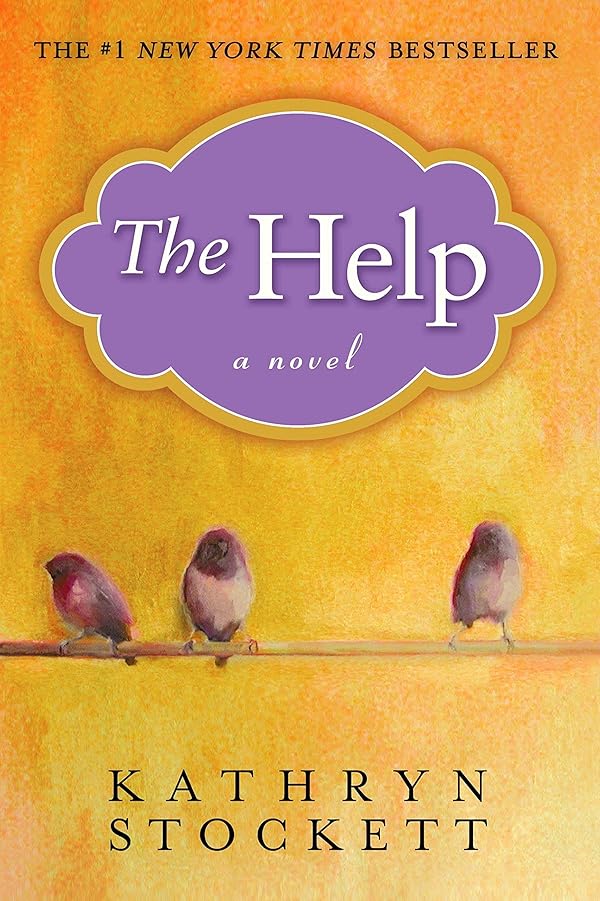
The Help
Kathryn Stockett
We may earn a commission on purchases — at no cost to you. As an Amazon Associate we earn from qualifying purchases. Disclosure.
The Help is a novel about three women in Jackson, Mississippi in 1962 who secretly collaborate on a book of anonymous testimony from Black maids about the white families who employ them. Kathryn Stockett builds her story on a quiet contradiction at the heart of the segregated South: white households handed their children, their kitchens and their most intimate business to women they would not let use the indoor bathroom. By moving between three narrators, two maids and one young white woman, the novel shows how ordinary domestic detail became the front line of a system, and how dangerous simple honesty could be.
- 1Three narrators carry the book: Aibileen Clark, a maid who has raised seventeen white children, Minny Jackson, her sharp-tongued friend, and Eugenia 'Skeeter' Phelan, a white graduate who wants to write.
- 2The plot turns on a secret manuscript of maids' testimonies that Skeeter compiles for a New York editor, Elaine Stein, at real physical risk to every woman who contributes.
- 3Hilly Holbrook's Home Help Sanitation Initiative, a campaign for separate outdoor bathrooms for domestic workers, is the specific insult that pushes Aibileen to talk.
- 4Skeeter's search for Constantine, the maid who raised her and vanished without explanation, is the private wound that drives her public project.
- 5Minny's revenge on Hilly, the pie she calls the Terrible Awful, becomes the insurance policy that keeps all the maids safe once the book is published.
- 6Real events press in from outside the plot, including the 1963 assassination of Medgar Evers in Jackson, which turns the women's project from risky into potentially fatal.
Key ideas
Intimacy without equality
The novel's central irony is domestic: white women trust Black women with their infants, their cooking and their secrets, while enforcing rules that treat them as contaminated. Aibileen has raised seventeen children who will grow up to employ women like her. The bathroom campaign makes the contradiction literal, since the same hands that are unfit to share a toilet seat are fit to feed the family.
Telling the story is the act of resistance
Nobody in the book stages a march or files a lawsuit. The rebellion is testimony, gathered at night in Aibileen's kitchen and typed on Skeeter's Corona. Stockett treats authorship as power: once these women's accounts exist in print, Jackson's polite fiction about happy servants cannot survive contact with them.
Aibileen's counter-script for Mae Mobley
Aibileen repeats a small daily affirmation to the neglected toddler she cares for, deliberately overwriting what the child will otherwise absorb from her mother and her town. It is the novel's clearest statement that prejudice is taught rather than inherited, and that a caregiver can teach something else. She also tells the girl invented stories about a Martian named Aibileen, smuggling in lessons about difference.
Hilly Holbrook as the machinery of respectability
Hilly is not a cartoon bigot but the president of the Junior League, a woman who runs charity drives for starving children in Africa while campaigning for segregated bathrooms at home. Her weapon is social exclusion: a whisper can end a marriage, a job or a lease. Through her, Stockett shows that segregation was sustained less by law than by the daily fear of being frozen out.
Celia Foote and the class line inside whiteness
Celia, a lonely woman from Sugar Ditch whom the League refuses to admit, hires Minny and then treats her as a friend, largely because she has never learned the rules. Her repeated miscarriages and her clumsy kindness make her the one white character with no stake in the hierarchy. Her arc argues that cruelty here is learned behaviour, maintained by people with something to lose.
Everybody pays a price
Yule May is arrested and jailed over a stolen ring after asking Hilly for a loan for her sons' tuition, and that injustice is what finally brings the other maids to Skeeter's door. Skeeter loses her boyfriend, her friends and her place in Jackson society. Stockett refuses a clean triumph: Aibileen ends the novel jobless and starting over, and the reader is left to decide whether that is a defeat.
Notable quotes
“You is kind. You is smart. You is important.”
— Aibileen to Mae Mobley
Who is it for?
Readers who love character-driven historical fiction with strong, distinct narrative voices will find this one hard to put down, and book clubs will get hours out of its arguments about who gets to tell whose story. It suits anyone interested in the domestic texture of the Jim Crow South, the everyday details that history books tend to skip. If you enjoyed the intergenerational warmth of Fried Green Tomatoes or the moral tension of To Kill a Mockingbird, this belongs on your shelf.
Full summary
Jackson, Mississippi, 1962. Aibileen Clark has spent her life raising other people's children and has recently buried her only son, Treelore, who died in an industrial accident. She works for Elizabeth Leefolt, whose toddler Mae Mobley she loves far more than the child's own mother seems to.
Eugenia 'Skeeter' Phelan returns from Ole Miss with a degree and an ambition to write, into a social circle where her friends are already married with children. She lands a job writing a household hints column for the local paper and starts asking Aibileen for answers, which is how the two women begin talking at all.
Skeeter's friend Hilly Holbrook is pushing the Home Help Sanitation Initiative, a proposal requiring separate outdoor bathrooms for domestic workers on the grounds that they carry different diseases. Skeeter also cannot get a straight answer about Constantine, the maid who raised her and left while she was away at college.
A New York editor, Elaine Stein, tells Skeeter to write about something that disturbs her. Skeeter proposes a book of interviews with maids about their working lives. Aibileen, after long hesitation, agrees, and eventually brings in Minny Jackson, who has just been fired by Hilly and blacklisted across town.
Minny finds work with Celia Foote, an outsider from a poor background whom the Junior League will not accept. Celia does not know the rules, treats Minny as company rather than staff, and hides the arrangement from her husband. Their awkward, genuine friendship runs alongside the main plot as its warmest thread.
The interviews stall until Yule May, Hilly's maid, is arrested and imprisoned after taking a ring to pay her twin sons' college fees. Outrage brings a dozen more maids to Aibileen's kitchen. The women work at night, terrified, as Medgar Evers is assassinated a few miles away and the danger stops being theoretical.
The book is published anonymously as Help, thinly disguising Jackson. The town reads it and starts guessing. Minny's confession about the Terrible Awful, the chocolate pie she served Hilly, is included precisely because Hilly will never admit the story is about her, which forces her to insist publicly that the book describes some other town.
The fallout lands unevenly. Skeeter takes a job in New York with her mother's blessing. Minny finally leaves her abusive husband, secure in permanent work with Celia. Aibileen is pushed out of the Leefolt house on a false accusation of theft, says goodbye to Mae Mobley, and walks home wondering whether, at fifty-three, a new life is still possible.