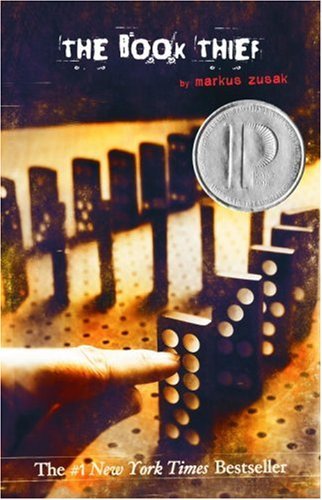
The Book Thief
Markus Zusak
We may earn a commission on purchases — at no cost to you. As an Amazon Associate we earn from qualifying purchases. Disclosure.
The Book Thief is narrated by Death, who tells the story of Liesel Meminger, a foster child in a small German town outside Munich who steals books through the years of the Third Reich. Markus Zusak's premise is that words built Hitler's power and can also undo it, and he tests that idea in a working-class household that hides a Jewish man in its basement while the daughter reads aloud in bomb shelters. It is a novel about ordinary Germans who were neither heroes nor monsters, told by a narrator who is exhausted by his job.
- 1Death narrates the entire novel, tells you the ending well in advance, and admits he is haunted by humans rather than the other way round.
- 2Liesel arrives on Himmel Street in 1939 having watched her brother die on the train, and steals her first book, a gravedigger's manual, at his burial.
- 3Her foster father Hans Hubermann teaches her to read at night in the basement and paints over slurs daubed on Jewish shopfronts.
- 4The Hubermanns hide Max Vandenburg, a Jewish fighter whose father saved Hans's life in the First World War, in their basement for nearly two years.
- 5Max writes Liesel two books over painted-out pages of Mein Kampf, The Standover Man and The Word Shaker, turning Nazi propaganda into a gift.
- 6An Allied bombing raid destroys Himmel Street while Liesel is writing in the basement, killing Hans, Rosa and Rudy Steiner and leaving her the only survivor of her street.
Key ideas
Death as a reluctant narrator
Zusak's narrator collects souls, notices the colours of the skies he works under, and is candid about needing distraction from what he sees. He spoils his own plot repeatedly, announcing deaths chapters early, which shifts the reader's attention from what happens to how people behave while it happens. His closing admission about being haunted reverses the usual relationship between humanity and mortality.
Words as the raw material of both tyranny and rescue
Max's allegory The Word Shaker imagines Hitler growing a forest of words and planting them in people's heads, and a girl who climbs one of his trees and refuses to come down. Liesel's arc runs from illiterate to writer, and her final act of theft is a blank notebook. The same technology that produced Mein Kampf produces the book that saves her life by keeping her in the basement.
The Hubermanns and quiet decency
Hans is an accordion player and house painter who is refused Nazi Party membership because he paints over anti-Jewish graffiti, and who ruins his own family's safety by handing bread to a starving Jewish prisoner on a march to Dachau. Rosa swears constantly, beats Liesel with a wooden spoon and sleeps holding Hans's accordion while he is away at war. Zusak's Germans are ordinary people making small, costly choices.
Rudy Steiner and the boy who never gets his kiss
Rudy paints himself black to run like Jesse Owens at the local track, steals with Liesel, is recruited and resisted by a Nazi elite school, and asks her for a kiss constantly. Death tells the reader early that Rudy will die without ever receiving one, and that foreknowledge colours every scene he appears in. He is the book's argument that the war's cost is measured in unfinished ordinary lives.
Stealing as resistance and appetite
Liesel's thefts begin as instinct and become deliberate: books rescued from a Hitler Youth bonfire, apples taken with Arthur Berg's gang, and repeated raids on the mayor's library, quietly permitted by Ilsa Hermann, a grieving woman who leaves the window open. Reading is the one thing nobody in Molching has assigned her, and that is exactly why it matters.
Shelters, basements and reading aloud
During air raids Liesel reads to the neighbours crowded in the Fiedlers' cellar and the room goes quiet. Later she reads to Frau Holtzapfel, who has lost her sons, in exchange for coffee and ironing. The novel keeps showing storytelling as a practical technology for surviving fear, not a metaphor.
Notable quotes
“I am haunted by humans.”
— Death, final line
Who is it for?
Readers who want a Second World War novel from an angle they have not seen, told in short, striking, almost poetic sections, will find this unforgettable, and it works equally well for older teenagers and adults. It is a natural pick for anyone who loved All the Light We Cannot See or The Boy in the Striped Pyjamas but wants something with more formal daring. Book clubs get a lot out of its narrator, its typographic experiments and its refusal to let anyone off easily.
Full summary
In 1939 nine-year-old Liesel Meminger is being taken with her brother to foster parents outside Munich when the boy dies on the train. At his graveside she picks up a book dropped in the snow, The Grave Digger's Handbook, though she cannot yet read a word of it. Death, who was there for the brother, notices her.
She arrives at 33 Himmel Street to Hans Hubermann, a gentle accordion player, and Rosa, who greets her with insults and love in the same breath. Hans discovers her book, discovers she cannot read, and starts teaching her in the middle of the night, painting words on the basement wall when paper runs short.
Liesel makes an ally in Rudy Steiner, the lemon-haired boy next door who idolises Jesse Owens and asks her for a kiss at every opportunity. They join a gang of fruit thieves, run races and deliver washing for Rosa. At a Hitler's birthday book burning, Liesel pulls a smoking survivor from the pile.
Max Vandenburg, a Jewish man carrying a copy of Mein Kampf as a disguise and a key hidden in its pages, arrives at the Hubermanns' door. Hans owes his life to Max's father from the First World War and hides him in the basement. Max and Liesel bond over nightmares, weather reports and boxing fantasies.
Max paints over the pages of Mein Kampf and writes Liesel two illustrated books on top of the whitewash, The Standover Man and The Word Shaker. When he falls dangerously ill, Liesel reads to him for weeks and brings him small gifts from the outside world.
The mayor's wife Ilsa Hermann, mute with grief for a son lost in the previous war, catches Liesel stealing from her library and responds by leaving the window unlatched. Later she gives her a blank notebook and tells her to write.
Max leaves to protect the family after Hans is seen giving bread to a prisoner on a march to Dachau. Hans is conscripted into an air raid unit as punishment. Rudy is selected for a brutal Nazi training school; his father is drafted instead. Liesel later sees Max in another prisoner column and is whipped for running to him.
One night Liesel is writing her own story in the basement when Allied bombers hit Himmel Street without warning. Everyone she loves dies in their beds. Death carries the souls away, picks up her discarded manuscript, and keeps it for decades before returning it to her in Sydney at the end of a long life.