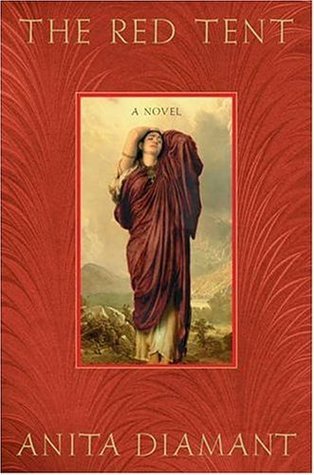
The Red Tent
Anita Diamant
We may earn a commission on purchases — at no cost to you. As an Amazon Associate we earn from qualifying purchases. Disclosure.
The Red Tent retells the Book of Genesis from the viewpoint of Dinah, Jacob's only daughter, who appears in the Bible mainly as the silent centre of a massacre. Anita Diamant imagines the rich female world behind the patriarchal narrative: the menstrual tent where the women of the tribe gathered, the goddess worship they kept alongside Jacob's God, and the midwifery skills passed from mother to daughter. It is a novel about reclaiming a woman written out of her own story, and about the intimate female culture that scripture left unrecorded.
- 1Dinah narrates her own life, giving voice to a biblical character who never speaks in Genesis.
- 2She has four mothers, the sisters Leah, Rachel, Zilpah and Bilhah, all wives of Jacob, who raise her collectively.
- 3The red tent is where women retreat during menstruation and childbirth, a space of female knowledge, ritual and goddess worship hidden from the men.
- 4Dinah becomes a skilled midwife, trained by Rachel, a craft that gives women power over life and death.
- 5In Genesis, Dinah's story is a rape avenged by her brothers; Diamant reframes it as a love affair with the Shechemite prince Shalem, whom her brothers Simon and Levi murder along with every man in his city.
- 6Dinah flees to Egypt, remakes her life as a midwife, and dies having been remembered, the novel's answer to a woman history forgot.
Key ideas
Giving a voice to the silent woman
In Genesis 34 Dinah is acted upon and never heard: she is taken, and her brothers slaughter a city in response. Diamant's central move is to let her speak, and to insist her story was a love match rather than the rape the men reported. The novel is a sustained argument that scripture recorded only what the patriarchs chose to see.
The red tent as female culture
The tent to which women withdraw during their periods and to give birth is the book's beating heart: a place of songs, stories, remedies and worship of the old goddesses. Diamant imagines the transmission of knowledge between generations of women that the Bible never mentions. It reframes menstruation and childbirth as sources of community rather than shame.
Four mothers, one daughter
Dinah is raised by all four of Jacob's wives, each distinct: Leah strong and fertile, Rachel beautiful and a gifted midwife, Zilpah mystical, Bilhah quiet and kind. Their sisterhood, rivalries and shared labour give Dinah a model of womanhood far larger than any single mother could. The collective mothering is itself the point.
Midwifery as women's power
Rachel trains Dinah to catch babies, and the craft runs through the novel as the one domain where women hold real authority over outcomes men cannot control. In Egypt it becomes Dinah's livelihood and her reputation. Diamant treats it as sacred work and as a practical form of independence.
The massacre retold
The Bible frames the slaughter at Shechem as righteous vengeance for Dinah's defilement. Diamant tells it as catastrophe: Dinah loved Shalem, was to marry him, and watched her brothers murder him and his whole city out of pride and greed. The reframing turns a story of honour into one of male violence destroying a woman's happiness.
Survival and remembrance
Dinah escapes to Egypt carrying Shalem's child, rebuilds herself as a healer, and eventually finds a kind of peace. The novel closes on the idea that being remembered is a form of immortality, and that Dinah, forgotten by scripture, is restored by the telling. Her name surviving is the book's final gift to her.
Who is it for?
Readers who love immersive historical and biblical fiction centred on women's lives will find this deeply rewarding, and it remains a landmark book club novel decades after publication. It suits anyone drawn to feminist retellings of familiar stories, or curious about the daily texture of the ancient world. Readers of The Mists of Avalon or Circe will recognise the same impulse to give the silenced woman her voice.
Full summary
Dinah introduces herself as a name barely present in scripture and promises to tell the story the Bible left out. She begins with her four mothers, the sisters Leah, Rachel, Zilpah and Bilhah, and the long tale of how the trickster Jacob came to marry all of them in the household of their father Laban.
As the only surviving daughter among many sons, Dinah is precious to all four women and is admitted early into the world of the red tent, where the women gather during menstruation and childbirth. There she absorbs songs, secrets, remedies and the worship of the household goddesses alongside Jacob's God.
Rachel, renowned as a midwife, takes Dinah as her apprentice. Dinah learns to ease labour and catch babies, a skill that gives her standing and purpose. The women's inner life, their rivalries, griefs and solidarity, unfolds largely out of sight of the men and their God.
The family, grown wealthy and tense, journeys toward Canaan. Along the way Dinah, now a young woman, is sent into the city of Shechem and meets its prince, Shalem. They fall in love and lie together, and Shalem asks his father to arrange a marriage, offering any bride price Jacob demands.
Jacob's sons, chiefly Simon and Levi, pretend to accept on condition that all the men of Shechem be circumcised. While the men lie recovering, the brothers fall on the city and slaughter every male, including Shalem. Diamant tells this not as vengeance for a rape but as the destruction of Dinah's chosen husband.
Devastated and pregnant, Dinah curses her father and brothers and flees to Egypt. She is taken in and bears Shalem's son, Re-mose, who is raised in comfort by Shalem's mother while Dinah's own grief slowly settles into a new life far from the family that betrayed her.
In Egypt Dinah rebuilds herself as a midwife of growing renown, marries again, and finds contentment. Years later she learns news of her brothers and her father's line, including Joseph's rise, and confronts the family history from a distance, no longer defined by it.
Near the end of her life Dinah discovers that her name and story have, against all odds, been remembered among the people she left. She dies at peace, having been the narrator of a life the Bible reduced to a single terrible episode, restored to fullness by the telling.