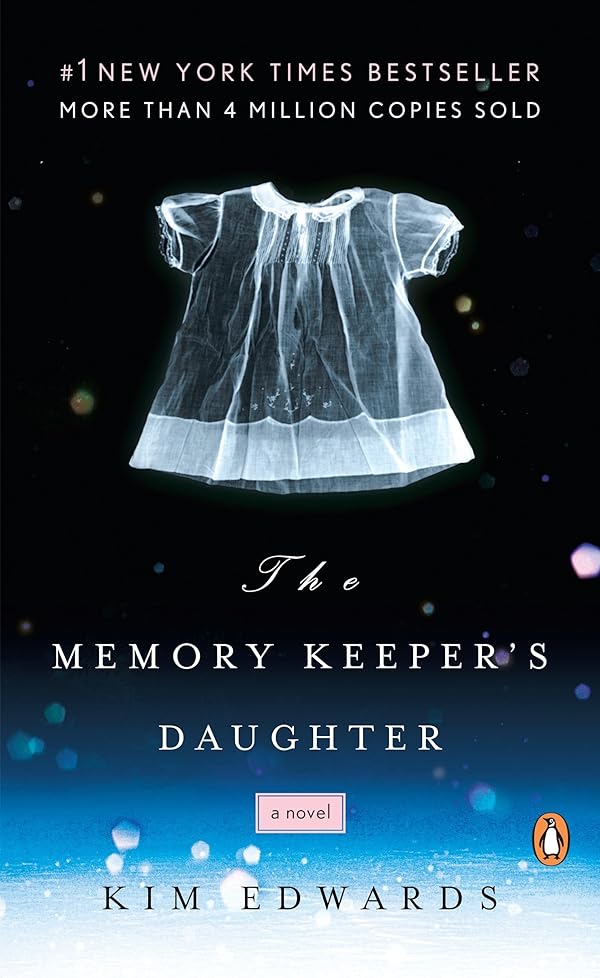
The Memory Keeper's Daughter
Kim Edwards
We may earn a commission on purchases — at no cost to you. As an Amazon Associate we earn from qualifying purchases. Disclosure.
The Memory Keeper's Daughter is Kim Edwards's haunting novel about the secrets families keep and the cost of choosing to forget. When his wife goes into premature labour, David Henry, a small-town doctor, makes a snap decision: his daughter is born with Down's syndrome, and he tells his wife the child died, then gives the baby to a nurse to raise in secret. Decades later, when his daughter Phoebe finds him, the lie unravels, and a family must reckon with the damage of silence. It is a profound meditation on how we live with the irreversible and how forgiveness, if it comes at all, comes slowly.
- 1David Henry, a perfectionist doctor, lies to his wife Caroline about the birth of their daughter Phoebe, telling her the premature baby died.
- 2David gives newborn Phoebe to a nurse named May to raise, providing money but never contact, so that no one learns the truth.
- 3Caroline grieves the daughter she never knew she had, and the lie calcifies into the foundation of her marriage and her son's life.
- 4Decades later, Phoebe, now an adult, seeks out David, and the buried secret is exposed, destroying the family's illusions about itself.
- 5David's perfectionism and fear of imperfection drive the lie; he cannot bear the idea of a child with an intellectual disability.
- 6The novel explores how one choice, made in a moment of panic, radiates through a lifetime, damaging everyone it touches.
Key ideas
The lie at the foundation
Everything in the Henry family flows from one choice, made in an instant, that lies cannot easily explain. David's decision shapes five decades of his wife's life, his son's childhood, and his secret daughter's identity. The novel asks what we owe to the truth and what we destroy when we choose comfort over it.
Perfectionism as cruelty
David's need for control and perfection leads him to reject his daughter for not being what he imagined. Edwards suggests that the pursuit of an ideal life is a form of violence against the real people who inhabit it, and that nothing damages families more thoroughly than unspoken grief.
The child unlived
Caroline spends decades mourning a daughter she never met and never knew existed. The phantom grief is sometimes harder to bear than actual loss, and Edwards renders with great sensitivity the particular pain of losing someone you never had the chance to love.
Phoebe as the truth
Phoebe, raised by May to be as whole and capable as anyone, is the living refutation of David's fears. She is not diminished or tragic; she is simply a person, and her existence proves that David's rejection was about his own failure, not her limitation.
The slow work of damage
Edwards does not treat forgiveness as a cathartic release or a neat ending. The family reckons with the lie slowly and incompletely, and some wounds do not heal. The novel respects the difficulty of living with profound betrayal.
How we know ourselves
Caroline and her son believed themselves to know their family, only to discover their entire history was built on a lie. Edwards is interested in how intimacy and ignorance can coexist, and how we construct identities within stories we don't fully understand.
Who is it for?
Readers who want a deeply moving family drama with moral complexity and emotional resonance will find this absorbing and painful in the best way. It suits anyone interested in how secrets shape families, disability representation, or the long arc of forgiveness. Readers of Jodi Picoult or Christina Schwarz will find it similarly gripping.
Full summary
In 1964, Caroline Gill, a young photographer, goes into premature labour and gives birth to twins: a healthy son, Paul, and a daughter, Phoebe, born with Down's syndrome. Her husband David, a perfectionist doctor, makes a decision in the delivery room that will reverberate through all their lives.
David tells Caroline that their daughter did not survive, and he ensures the lie holds by giving newborn Phoebe to May, a nurse with connections and means, to raise as her own. David provides money for decades but insists on no contact, no acknowledgement, no truth.
Caroline, believing her daughter is dead, grieves in silence, never sharing her sorrow with David or Paul. The unspoken grief becomes the hidden architecture of the marriage, and David's lie, meant to protect them all from imagined suffering, actually creates a different kind of pain.
Paul grows up believing he was meant to be a twin, and the missing sister haunts his sense of self. He becomes a musician, constructing his identity partly in the space left vacant by the sister he never knew he had.
Phoebe grows up in May's house, loved and educated and treated as fully capable, developing into a thoughtful, curious young woman who is not defined by her disability. She is whole precisely in the way David feared she could not be.
As David ages, the weight of the secret presses on him, and when Phoebe, now an adult, begins searching for her origins and discovers the truth, the careful construction of the Henry family's self-image collapses.
Phoebe forces contact with the family that rejected her, and the lie is exposed. Caroline discovers that the daughter she has grieved for decades is alive, and David is forced to face the consequences of his perfectionism and cowardice.
In the aftermath, the family must learn to live with betrayal and irreversible loss. Forgiveness, if it comes, does so slowly and incompletely. Edwards suggests that some wounds do not heal, and that healing, when it happens, is not redemptive but simply a new way of living with damage.