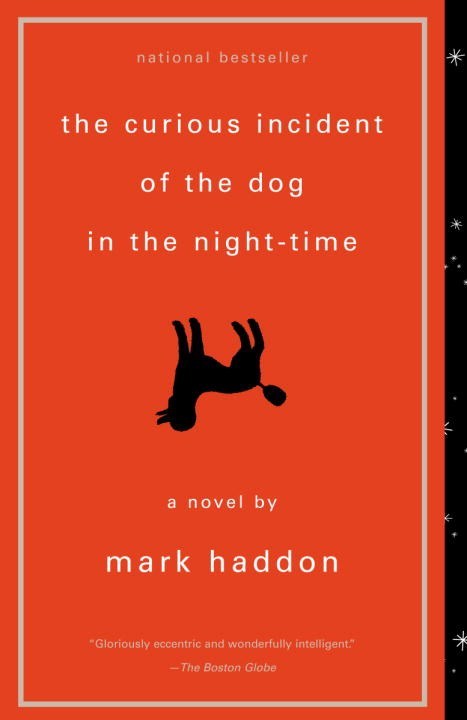
The Curious Incident of the Dog in the Night-Time
Mark Haddon
We may earn a commission on purchases — at no cost to you. As an Amazon Associate we earn from qualifying purchases. Disclosure.
The Curious Incident of the Dog in the Night-Time is narrated by Christopher Boone, a fifteen-year-old with an extraordinary mind for mathematics and a literal, pattern-seeking way of experiencing the world, who sets out to solve the killing of a neighbour's dog and uncovers a far more upsetting truth about his own family. Mark Haddon structures the book as Christopher's own detective account, complete with diagrams and prime-numbered chapters, so the reader experiences the world through his logic. It is a mystery, a coming-of-age story, and above all an exercise in seeing through a mind that works differently.
- 1Christopher finds his neighbour's dog Wellington killed with a garden fork and decides to investigate, modelling himself on Sherlock Holmes.
- 2He narrates the book himself as the account of his investigation, numbering the chapters with prime numbers rather than consecutively.
- 3Christopher cannot bear being touched, hates the colours yellow and brown, and calms himself by doing maths, which shapes how the whole story is told.
- 4His father has told him his mother is dead; investigating the dog, Christopher discovers a hidden cache of letters proving she is alive in London.
- 5He learns his father killed Wellington and lied about his mother, who left the family, which shatters his trust and frightens him into running away.
- 6Christopher travels alone across the country to London to find his mother, an ordeal for someone overwhelmed by crowds and noise, and the journey is the real climax of the book.
Key ideas
The world seen through Christopher's mind
Haddon never labels Christopher's condition, but the narration immerses the reader in it: sensory overload in busy places, distress at being touched, comfort in prime numbers and timetables, and a complete inability to interpret lies or metaphor. The book's achievement is that the reader learns to navigate the world as Christopher does rather than merely reading about him.
A detective story that turns domestic
The mystery of who killed Wellington is the engine, but the real revelation is not about the dog. Christopher's methodical investigation leads him to a box of letters and the discovery that the two adults he depends on have both deceived him. Haddon uses the detective frame to walk the reader into a story about a broken marriage.
Literal truth and the impossibility of lying
Christopher cannot lie and cannot understand why others do, which makes his father's deception about his mother catastrophic rather than merely sad. Once one lie is exposed, Christopher can no longer trust anything his father says, including that he is safe. The novel shows how a mind built on literal truth experiences betrayal.
The journey to London
The set piece is Christopher travelling alone by train and Underground to find his mother, navigating a sensory environment that terrifies him, holding his pet rat Toby, following signs and rules he has to invent as he goes. For most readers it would be a routine trip; Haddon makes clear it is the bravest thing Christopher has ever done.
Parents who fail and keep trying
Neither parent is a villain. Christopher's father lied out of grief and love and loses his son's trust as a result; his mother left because she could not cope and has to earn her way back. Haddon writes the exhaustion and guilt of raising a child the world is not built for, without sentimentality.
The maths and the shape of the book
Christopher's love of numbers is not decoration. The prime-numbered chapters, the diagrams, the appendix containing a maths proof, all reproduce how his mind orders a chaotic world. His ambition to take A-level maths and become a scientist is the novel's quiet statement that a different mind is a capable one.
Who is it for?
Readers who want a moving, funny, and formally inventive novel that shifts how they see a different kind of mind will find this unforgettable and quick to read. It works beautifully for younger and adult readers alike and is a frequent classroom and book club choice. Anyone who valued Flowers for Algernon or Wonder will appreciate its empathy and craft.
Full summary
Christopher Boone, fifteen, lives with his father in Swindon. One night he discovers Wellington, the large poodle belonging to his neighbour Mrs Shears, dead on her lawn, killed with a garden fork. Christopher, who loves animals and structure, decides to find out who did it and to write a book about his investigation.
He explains himself as he goes: he is brilliant at mathematics, knows every prime number up to a huge figure, cannot stand being touched or the colours yellow and brown, and finds people baffling because they say things they do not mean. His father, who raises him alone, has told him his mother died of a heart attack two years earlier.
Christopher's questioning of the neighbours annoys his father, who forbids him to continue. But while searching the house, Christopher finds a cache of letters addressed to him, hidden away, written in his mother's hand and dated well after her supposed death. His father had lied: she is alive.
Confronted, his father confesses the larger truth. Christopher's mother did not die; she left, having had an affair with Mr Shears and been unable to cope with family life. Worse, his father admits that he himself killed Wellington in a rage after an argument with Mrs Shears.
Terrified of a father who has both lied to him and killed, Christopher decides he can no longer stay. He resolves to travel to London, where the letters show his mother now lives, an undertaking that means leaving the small ordered world he can manage for the overwhelming one he cannot.
The journey is an ordeal. Christopher endures the noise and crush of the train station, the Underground, and the crowds, following rules he invents to keep himself functioning, nearly losing his pet rat Toby on the tracks, and pushing through sensory panic that would stop most people cold.
He reaches his mother, who is stunned and overjoyed, though her life with Mr Shears is unstable and cannot easily absorb a teenage son with complex needs. The relationship strains, and she eventually leaves Mr Shears and returns with Christopher toward Swindon.
Back home, Christopher's father works slowly to rebuild trust, beginning by giving his son a puppy as proof of good faith. Christopher sits his A-level maths exam and achieves top marks, and the book closes with his conviction that having solved the mystery, survived the journey and passed the exam, he can do anything.