My Sister's Keeper
Jodi Picoult
We may earn a commission on purchases — at no cost to you. As an Amazon Associate we earn from qualifying purchases. Disclosure.
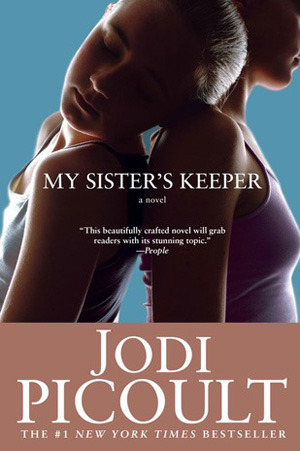
My Sister's Keeper is a novel about Anna Fitzgerald, thirteen, who was conceived through genetic selection to be a tissue match for her older sister Kate and who sues her parents for the right to refuse a kidney donation. Jodi Picoult rotates the narration across the whole family and their lawyers so that no position is straightforwardly wrong, then delivers a final turn that recasts the entire case. It is a courtroom novel built on a genuine bioethical question: whether a child can be created as a treatment and still be a person with a veto.
- 1Anna was conceived using preimplantation genetic diagnosis specifically to be a perfect donor match for Kate, who has acute promyelocytic leukaemia.
- 2By thirteen she has undergone cord blood harvesting, repeated blood draws, bone marrow extraction, granulocyte donations and lymphocyte infusions.
- 3She hires Campbell Alexander and petitions for medical emancipation to stop a kidney transplant her parents have already assumed she will provide.
- 4Sara Fitzgerald, a former lawyer, represents herself against her own daughter, which makes every hearing a family argument conducted under oath.
- 5Their brother Jesse, ignored throughout, has been setting fires across the city, a fact his firefighter father works out for himself.
- 6Anna wins the case, then is killed in a car accident on the way from court, and her kidney goes to Kate, who survives into remission.
Key ideas
A child conceived as a treatment
The novel takes a real medical practice, the saviour sibling, and follows it thirteen years past the delivery room. Sara and Brian's decision is presented sympathetically at the moment they make it, with a two-year-old dying in front of them. The question Picoult raises is what obligations that origin creates, and whether consent can exist where a child has never once been asked.
Rotating narration as an ethical device
Anna, Sara, Brian, Jesse, Campbell and Julia each narrate, with Sara's chapters running back through the years of Kate's illness. The structure makes it nearly impossible to settle on a villain: Sara's tunnel vision is also fifteen years of keeping a child alive. Readers routinely change sides mid-book.
The invisible siblings
Jesse is the novel's quietest indictment. Useless as a donor and therefore surplus to the family's central project, he drinks, steals cars and sets buildings alight, which is the only reliable way he has found to be noticed. His father, a fire captain, eventually recognises his own son's work at a scene.
Campbell, Julia and the parallel plot
Campbell Alexander takes the case for reasons he will not explain and has a service dog he refuses to account for; he is epileptic and left Julia Romano years ago rather than make her live with it. Julia is appointed guardian ad litem. Their reconciliation mirrors the main plot's theme of protecting people by making decisions for them.
The turn that reframes the case
On the stand, Anna reveals that Kate asked her to refuse. Kate, exhausted after years of treatment, wants to die and knows her parents will never allow it while a donor exists. The lawsuit was never Anna's rebellion; it was the only route to her sister's wish.
An ending that refuses relief
Anna wins medical emancipation and Campbell is granted power of attorney over her medical decisions. Minutes later she is hit by a truck. Campbell authorises the donation she had just won the right to refuse, and Kate lives, which leaves the reader holding a resolution nobody in the book chose.
Who is it for?
Readers who like fiction that argues with itself, where every character has a defensible position, will find this compulsively readable and hard to stop thinking about. It is one of the most reliable book club novels in print because the ending guarantees disagreement. Anyone interested in medical ethics, or who enjoyed The Fault in Our Stars or Little Fires Everywhere, will find plenty here.
Full summary
Kate Fitzgerald is diagnosed with acute promyelocytic leukaemia at two. No family member is a match, and a geneticist suggests conceiving a child selected as a donor. Sara and Brian agree, and Anna is born with a purpose already assigned.
Anna's childhood is a sequence of procedures: cord blood at birth, then lymphocytes, granulocytes, bone marrow drawn under anaesthetic. She narrates these matter-of-factly, having never known anything else, and can recite the details of her sister's disease better than her own timetable.
At thirteen, with Kate in renal failure, Anna takes seven hundred dollars of collected locket money to Campbell Alexander, a sharp Providence lawyer with a service dog called Judge, and asks him to sue her parents for the right to make her own medical decisions.
Sara, a lawyer who stopped practising to manage Kate's illness, decides to represent the family herself. Julia Romano is appointed guardian ad litem to determine what is actually in Anna's interests, a job complicated by the fact that Anna keeps refusing to explain herself.
Sara's chapters run in parallel through the years of treatment: the first remission, the relapses, the arsenic trioxide, the marrow transplant, the graft-versus-host disease. They show a mother whose entire life has been reorganised around one child and who cannot see what that has cost the other two.
Jesse, the eldest, drinks and steals and sets fires, and Brian, a fire captain, slowly assembles the evidence pointing at his own son. Their conversation about it is the book's most restrained scene. Brian also moves out with Anna during the case, unable to take a side and unwilling to leave her alone.
On the stand, Anna finally explains. Kate, worn out after fourteen years of treatment, asked her to stop, knowing that their mother would never let her go while a compatible donor lived in the same house. The petition was Kate's request, carried out by the only person who could.
The judge grants Anna medical emancipation and names Campbell as her medical power of attorney. Driving away from the courthouse, Campbell's car is hit by a truck and Anna is left brain dead. He authorises the transplant. Kate receives her sister's kidney, recovers, and narrates the final chapter as an adult who is alive because of it.