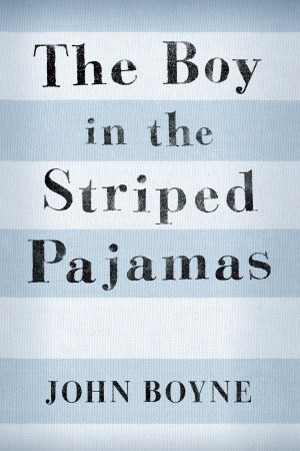
The Boy in the Striped Pajamas
John Boyne
We may earn a commission on purchases — at no cost to you. As an Amazon Associate we earn from qualifying purchases. Disclosure.
The Boy in the Striped Pajamas is John Boyne's controversial novel told from the perspective of Bruno, a young boy who is the son of a Nazi commandant at a concentration camp. Bruno befriends Shmuel, a Jewish boy on the other side of the fence, and through their friendship Boyne portrays the Holocaust as seen through children's innocent eyes, though not without disturbing complexity.
- 1Bruno is the young son of a Nazi commandant who moves with his family to a house beside a concentration camp.
- 2Bruno does not initially understand what the camp is or why there is a fence separating him from the people on the other side.
- 3He befriends Shmuel, a Jewish boy living in the camp, and they form an unlikely friendship despite the fence between them.
- 4As the novel progresses, Bruno becomes aware of the horror of what the camp is, though his understanding remains filtered through a child's perception.
- 5The novel portrays how ideology and propaganda affect Bruno's understanding of the world around him.
- 6The friendship between Bruno and Shmuel becomes a lens through which to explore the dehumanisation of the Holocaust.
Key ideas
Innocence in the face of horror
Boyne portrays Bruno as innocent and unaware, allowing readers to experience the gradual realisation of horror through a child's eyes.
The impact of propaganda
Bruno has been raised with Nazi ideology and must gradually confront the reality that contradicts what he has been taught.
Friendship as bridge
The friendship between Bruno and Shmuel bridges the physical and ideological divide between them, suggesting the arbitrariness of the categories that divide them.
The dehumanisation of the Holocaust
The novel portrays how the systematic dehumanisation of prisoners allows ordinary people to participate in extraordinary horror.
The perspective of the perpetrator
Boyne's choice to tell the story from the perspective of a Nazi commandant's son is controversial but offers insight into how ordinary families were complicit.
The loss of childhood
The novel is ultimately tragic because it portrays the loss of innocence and childhood in the face of historical horror.
Who is it for?
Readers interested in Holocaust literature and in alternative perspectives on this history will find this thought-provoking and moving. It is widely read in schools, though teachers must carefully frame the novel's controversial perspective. Readers should be prepared for disturbing subject matter related to the Holocaust.
Full summary
Bruno is an eight-year-old boy living with his family in Berlin. His father is a high-ranking Nazi officer, and Bruno has been raised with Nazi ideology.
Bruno's family is moved to Poland when his father takes command of a concentration camp. Bruno initially does not understand what the camp is or why there is a fence dividing the landscape.
Exploring near the fence, Bruno meets Shmuel, a Jewish boy roughly his age who is living in the camp. Despite the fence, they form a friendship.
Bruno and Shmuel meet regularly, with Bruno bringing food and the two boys becoming close friends. Bruno remains largely unaware of the true nature of the camp and of Shmuel's circumstances.
Gradually, Bruno becomes aware that something is wrong. He hears conversations, notices changes, and begins to understand that the camp is not what he initially thought.
Bruno's understanding is complicated by his upbringing and by the propaganda he has absorbed. He must reconcile what he has been taught with the reality he is beginning to perceive.
As the war progresses, the threat to everyone at the camp increases. The novel moves toward a tragic climax.
The ending of the novel is deliberately ambiguous and tragic, leaving readers to confront the implications of Bruno's innocence in the face of historical horror.