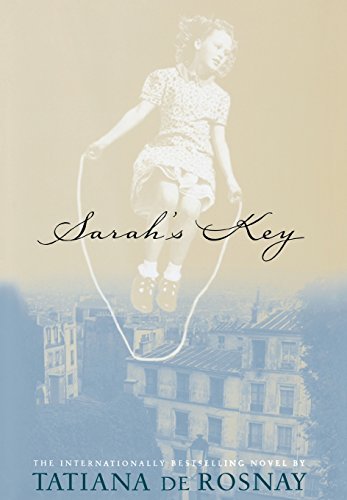
Sarah's Key
Tatiana de Rosnay
We may earn a commission on purchases — at no cost to you. As an Amazon Associate we earn from qualifying purchases. Disclosure.
Sarah's Key interweaves two stories: a ten-year-old Jewish girl caught in the 1942 Vel d'Hiv roundup in Paris, and a modern American journalist in the city who uncovers what happened to her. Tatiana de Rosnay uses the connection between them to force a reckoning with a wartime atrocity carried out by French police against French Jews, a chapter France was long reluctant to confront. It is a novel about buried guilt, the cost of secrets, and the responsibility the present owes the past.
- 1In July 1942 French police, not Germans, arrested thousands of Jewish families in Paris and held them in the Velodrome d'Hiver in appalling conditions before deportation to Auschwitz.
- 2Ten-year-old Sarah Starzynski locks her little brother Michel in a hidden bedroom cupboard to keep him safe, promising to return, and takes the key with her.
- 3The narrative alternates between Sarah's experience in 1942 and journalist Julia Jarmond investigating the Vel d'Hiv sixty years later.
- 4Julia discovers that the apartment her French husband's family has owned for decades is the very one the Starzynskis were taken from.
- 5Sarah escapes the transit camp, returns to the apartment, and finds her brother dead in the cupboard, a discovery that shapes the rest of her life.
- 6Julia traces Sarah's fate to America and eventually meets her son, who never knew his mother's history, connecting the two timelines.
Key ideas
The atrocity France tried to forget
The Vel d'Hiv roundup was carried out by French police under the Vichy regime, targeting French and foreign Jews including thousands of children. De Rosnay foregrounds that it was not the occupiers but French authorities who did it, a fact France did not officially acknowledge until 1995. The novel is partly an act of national memory.
The key and the promise
Sarah locks her brother Michel in their secret cupboard to hide him from the police, certain she will be back within hours, and keeps the key throughout the ordeal. The key becomes the novel's central object, a symbol of a promise made in innocence that circumstance turns into a lifelong wound.
Two timelines converging
De Rosnay alternates Sarah's 1942 chapters with Julia's present-day investigation, gradually collapsing the distance between them. The structure lets the reader feel history reaching into the present, especially once Julia realises her own family is directly implicated in Sarah's story.
Inherited complicity
Julia learns that the Tezac family, into which she married, moved into the Starzynskis' apartment shortly after they were taken, and that her husband's grandfather knew. The novel asks what descendants owe for a past they did not choose, and whether uncovering an ugly truth is worth the disruption it causes.
The cost of carrying it
Finding Michel's body destroys something in Sarah that never heals. She survives, emigrates, marries and has a son, but the trauma follows her and shapes a life lived under a name and a silence. De Rosnay is unsparing about how survival is not the same as recovery.
Julia's parallel reckoning
Julia's obsession with Sarah's story runs alongside a crumbling marriage and a difficult pregnancy, and the two threads inform each other. Bearing witness changes her, straining her relationships but giving her a moral clarity she lacked. The novel suggests that truly reckoning with the past always costs the person who does it.
Who is it for?
Readers who want emotionally powerful historical fiction that illuminates a lesser-known chapter of the Holocaust will find this moving and hard to forget, and its dual timeline makes it a strong book club choice. It suits anyone interested in French wartime history and the ethics of memory. Readers of The Nightingale or Suite Francaise will find it a natural companion.
Full summary
In July 1942, French police come in the night for the Starzynski family in their Paris apartment. Ten-year-old Sarah, thinking she is protecting him, hides her four-year-old brother Michel in a concealed cupboard in their bedroom, locks it, pockets the key, and promises to come back and let him out soon.
Sarah and her parents are taken to the Velodrome d'Hiver, an indoor cycling stadium where thousands of Jewish families are held for days in unbearable heat with almost no water, food or sanitation. From there they are moved to a transit camp outside the city, where families are brutally separated.
Sixty years later, Julia Jarmond, an American journalist married to a Frenchman and living in Paris, is assigned to write about the Vel d'Hiv roundup on its anniversary. As she researches, she is struck by how thoroughly the event has been suppressed in French memory and by how little her own French acquaintances know of it.
Sarah, tormented by the locked cupboard, escapes the camp with another girl and is helped by an elderly French couple who shelter her. Consumed by her promise, she makes her way back to the Paris apartment to free Michel, only to open the cupboard and find that he has died inside.
Julia discovers that the apartment her husband's family has owned for generations, the one she and Bertrand are about to renovate and move into, is the same apartment the Starzynskis were seized from. Her husband's grandfather took it over almost immediately after they were deported.
Determined to learn what became of Sarah, Julia follows a trail through records, survivors and reluctant relatives. She uncovers the full story of the cupboard and Michel's death, and the family's discomfort at having her expose a history they would rather leave buried.
Julia's marriage deteriorates as her obsession grows, complicated by a pregnancy her husband does not want. Her pursuit of Sarah becomes bound up with her own decisions about integrity, motherhood and what kind of life she wants to live.
Julia traces Sarah to the United States, where she had emigrated, married and had a son, William, before dying years earlier. She finds William, who knew nothing of his mother's childhood, and gives him the truth of who Sarah was, connecting the two timelines and honouring a promise made across sixty years.