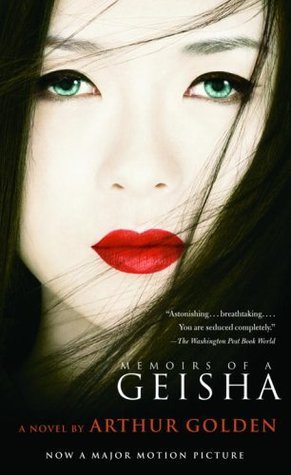
Memoirs of a Geisha
Arthur Golden
We may earn a commission on purchases — at no cost to you. As an Amazon Associate we earn from qualifying purchases. Disclosure.
Memoirs of a Geisha is a novel narrated by Sayuri, a fisherman's daughter sold to a Kyoto okiya at nine who becomes one of Gion's most celebrated geisha before the Second World War ends the world she trained for. Arthur Golden frames it as a memoir told in retirement in New York, and builds it around one sustaining fact: that everything Sayuri achieves is aimed at a man who once showed her kindness on a bridge. It is a novel about a closed and highly technical profession, and about what ambition looks like when a woman has no legal power at all.
- 1Chiyo Sakamoto and her sister Satsu are sold by their dying father in 1929 and separated, Chiyo to a respectable okiya in Gion and Satsu to a brothel.
- 2Hatsumomo, the okiya's reigning geisha, systematically sabotages Chiyo to prevent a rival ever being trained.
- 3Mameha, an elite geisha with her own reasons to oppose Hatsumomo, takes Chiyo on as a younger sister and renames her Sayuri.
- 4Sayuri's mizuage, the auctioning of her virginity, sets a record price and is the transaction that clears her debts and secures her independence.
- 5A chance kindness from the Chairman, Ken Iwamura, when Sayuri was a crying child on a bridge becomes the private motive behind her entire career.
- 6The Second World War closes Gion, and Sayuri spends the war years making kimonos in Arashiyama before the profession is partially rebuilt for occupying officers.
Key ideas
A geisha is an artist and an asset
Golden is careful to distinguish geisha from prostitutes while refusing to romanticise the economics. Sayuri accumulates enormous debt for her training, kimono and food, and repays it through performance fees and a danna, a patron who covers her expenses in exchange for exclusivity. Her freedom is measured in yen owed.
Water and wood
The novel's recurring image is Sayuri's excess of water in her personality, which lets her flow around obstacles rather than through them. Hatsumomo, by contrast, is fire and burns herself out. Golden uses the elemental readings that a fortune teller gives the characters as an organising principle for how each one meets adversity.
Hatsumomo and rivalry as survival
Hatsumomo is beautiful, cruel and correct about one thing: an okiya only needs one earner. She plants stolen goods to have Chiyo blamed, ruins her prospects with gossip, and destroys a kimono to frame her. Her eventual disgrace and expulsion is not a triumph so much as an illustration of what the system does with women it no longer needs.
Mameha's long game
Mameha's mentorship is a strategic campaign: she engineers Sayuri's introductions, orchestrates a bidding war for her mizuage between Dr Crab and Nobu, and calculates each appearance for maximum effect. Golden's most interesting material is this procedural detail, the geisha world run as a business with contracts, alliances and reputations.
The Chairman and the handkerchief
The Chairman finds Chiyo weeping by the Shirakawa stream, buys her a shaved ice, and gives her his handkerchief. She keeps it for decades. Everything she does after, including years in a profession she did not choose, is organised around being placed close enough to him to be noticed.
Nobu, and the debt of loyalty
Nobu Toshikazu, scarred and blunt, is the one man who values Sayuri for her character rather than her image, and who protects her through the war. Her decision to make herself unacceptable to him, by arranging to be discovered with the Minister, is the least flattering thing she does. Golden lets it stand as a cost.
The war ends the world it describes
Gion closes, kimono are sold for food, and geisha scatter to factories or, in Sayuri's case, a kimono maker's household in Arashiyama. What returns afterwards is partly staged for American officers. The memoir is therefore an account of a profession at the exact moment it stopped being what it had been.
Notable quotes
“Adversity is like a strong wind.”
— Sayuri
Who is it for?
Readers who want richly detailed historical fiction with an immersive sense of a vanished world will find this exceptionally absorbing, and the procedural detail of geisha training is fascinating in its own right. It works well for book clubs interested in questions of agency, class and how a story of another culture should be told. Anyone who loved Snow Flower and the Secret Fan or Pachinko will recognise the appeal.
Full summary
In 1929, in the poor fishing village of Yoroido, nine-year-old Chiyo Sakamoto and her older sister Satsu are sold by a family broker as their mother dies and their father gives up. Chiyo, noted for her unusual grey-blue eyes, is taken to an okiya in the Gion district of Kyoto. Satsu is sent to a brothel.
The okiya is dominated by Hatsumomo, its only working geisha, who understands immediately that Chiyo is a threat and sets out to destroy her. Chiyo works as a maid, fails at school, attempts to escape with Satsu, falls from a roof, and is told her training is finished and her debts are permanent.
Weeping by the Shirakawa stream, she is noticed by a middle-aged businessman known as the Chairman, who speaks kindly to her, buys her a sweet ice and leaves her his handkerchief and some money. She decides on the spot that becoming a geisha is the only route to seeing him again.
Mameha, one of Gion's most successful geisha and an old enemy of Hatsumomo, offers to take Chiyo as her younger sister. She is renamed Sayuri, resumes training in dance, shamisen, tea ceremony and conversation, and is launched with a series of carefully staged appearances.
Mameha engineers competition for Sayuri's mizuage between Dr Crab, a collector of such transactions, and Nobu Toshikazu, an executive at Iwamura Electric. The record price it fetches clears her debts and makes her the okiya's designated heir, displacing Hatsumomo, who is eventually expelled and disappears.
The Chairman is Nobu's business partner. Sayuri realises this early and spends years in his presence unable to say so, while Nobu falls in love with her. Her professional obligations and her private motive point in opposite directions for most of her career.
The war closes Gion. Kimono are sold, geisha take factory work, and Nobu arranges for Sayuri to be hidden with a kimono maker in Arashiyama, an intervention that saves her. She returns after the war to a district being reassembled for American officers.
Nobu intends to become her danna. To prevent it, Sayuri arranges to be discovered with the Minister, a man Nobu despises, and it works: he withdraws entirely. The Chairman, who had known who she was since the bridge, becomes her patron instead. She eventually moves to New York and opens a small teahouse, telling this story late in life.