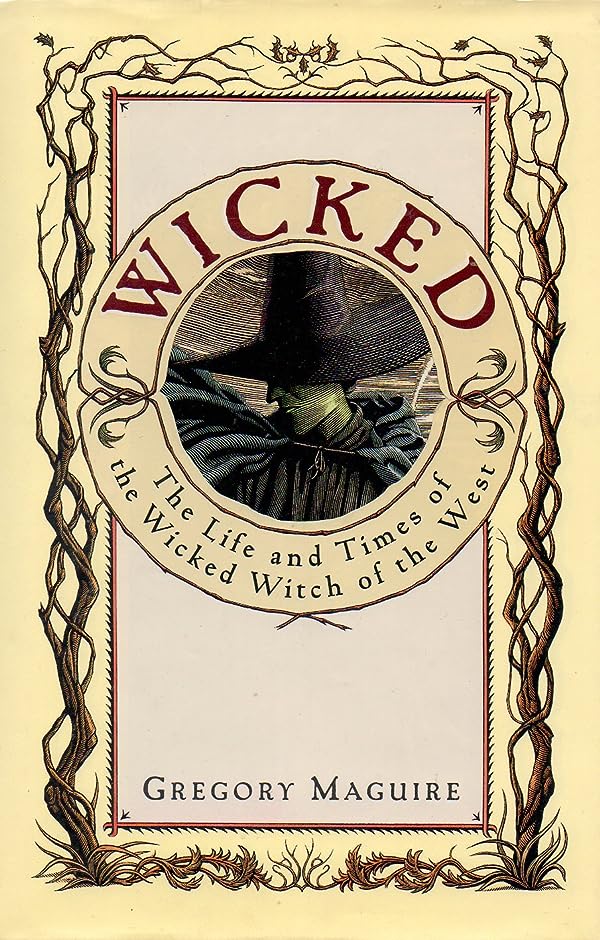
Wicked: The Life and Times of the Wicked Witch of the West
Gregory Maguire
We may earn a commission on purchases — at no cost to you. As an Amazon Associate we earn from qualifying purchases. Disclosure.
Wicked: The Life and Times of the Wicked Witch of the West is Gregory Maguire's retelling of the Wizard of Oz from the perspective of Elphaba, the Wicked Witch. Through Elphaba's story, Maguire explores how history is written by the victors and how a woman can be cast as evil simply for opposing an unjust regime. It is a sophisticated literary novel that deconstructs the Wizard of Oz and offers a darker, more complex alternative narrative.
- 1Elphaba is born green-skinned in a world that has no tolerance for such difference, setting her apart from the beginning.
- 2She becomes a political activist, opposing the Wizard's tyranny and his mistreatment of animals, who possess human-level consciousness.
- 3Elphaba's activism is portrayed as morally justified, though her methods become increasingly extreme as she despairs of peaceful change.
- 4Dorothy arrives in Oz and, influenced by the Wizard's propaganda, comes to believe that Elphaba is truly wicked and must be destroyed.
- 5Maguire portrays Dorothy as naive and manipulated rather than heroic, suggesting that the original story told was fundamentally dishonest.
- 6Elphaba's final fate is left ambiguous, allowing for the possibility that the Wizard's narrative about her death is as false as his other propaganda.
Key ideas
The unreliability of history
Maguire's central argument is that history is written by those in power, and that the Wizard's version of events is propaganda rather than truth.
Activism and extremism
Elphaba's journey from idealistic activist to someone willing to use violence explores how despair and repeated failure can radicalise even good-intentioned people.
Difference and otherness
Elphaba's green skin makes her an outsider, and Maguire explores how societies treat those who look different or think differently.
The corruption of power
The Wizard is not a benevolent ruler but a manipulative dictator who uses propaganda and violence to maintain control.
Morality and perception
Maguire argues that morality is not objective but is constructed through narrative and propaganda, and that Elphaba is perceived as evil because the Wizard has defined her so.
Innocence and manipulation
Dorothy is portrayed as innocent but also as manipulated, allowing her to participate in evil without recognising it as such.
Who is it for?
Readers who love The Wizard of Oz will find this a sophisticated and provocative reinterpretation. It suits anyone interested in literary retellings of classic stories and in exploring moral complexity. Readers should be prepared for the novel's length and philosophical complexity, and for its challenge to beloved source material.
Full summary
Elphaba is born with green skin in a world that has no tolerance for such difference. Her otherness marks her from birth and shapes her entire life.
She grows up brilliant but isolated, eventually attending university where she becomes politically aware and begins to oppose the Wizard's regime.
Elphaba discovers that the Wizard is systematically dehumanising Animals (sentient creatures), treating them as property rather than as moral beings.
She becomes an activist, working to oppose the Wizard's policies and to protect Animals. Her activism is moral but becomes increasingly desperate as the Wizard's power grows.
Elphaba's activism makes her famous and infamous. The Wizard uses propaganda to paint her as wicked and dangerous, turning public opinion against her.
When Dorothy arrives in Oz, she is taught by the Wizard that Elphaba is evil and must be stopped. Dorothy, naive and manipulated, becomes the instrument of the Wizard's propaganda.
Elphaba finds herself hunted by the Wizard and by Dorothy, her methods becoming increasingly extreme as she despairs of peaceful change.
Maguire ends ambiguously about Elphaba's final fate, suggesting that the Wizard's version of her death may be as false as everything else he has claimed.