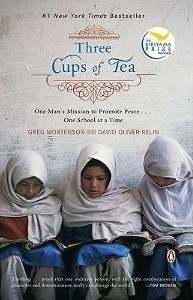
Three Cups of Tea: One Man's Mission to Promote Peace ... One School at a Time
Greg Mortenson
We may earn a commission on purchases — at no cost to you. As an Amazon Associate we earn from qualifying purchases. Disclosure.
Three Cups of Tea is Greg Mortenson's memoir of his mission to build schools in remote areas of Afghanistan and Pakistan, told through his journey from grief-stricken climber to humanitarian. After nearly dying on K2, Mortenson becomes committed to building schools in the poorest communities of Central Asia, believing that education is the most effective path to stability and peace. The memoir chronicles his efforts to raise funds, navigate political challenges and build relationships with local communities in the name of transforming lives through education.
- 1Mortenson is a climber who nearly dies on K2 and is rescued by a remote Pakistani village, an experience that transforms his life's trajectory.
- 2Moved by the village's poverty and lack of educational opportunity, he commits to building a school there, the first of what becomes a global network.
- 3The book chronicles his efforts to raise funds, often travelling to speak to audiences about his work and the transformative power of education.
- 4Mortenson navigates the complexities of working in remote areas of Afghanistan and Pakistan, building relationships with local community leaders and overcoming political obstacles.
- 5The memoir becomes a testament to the idea that education, particularly girls' education, is a powerful tool for creating peace and stability.
- 6Mortenson's journey is portrayed as one of conviction and perseverance in the face of overwhelming obstacles.
Key ideas
Education as peace-building
Mortenson argues that education, particularly girls' education, is the most effective long-term strategy for creating peace and stability in conflict zones. Schools create educated populations less vulnerable to extremism.
Cultural humility as prerequisite
Mortenson's success comes from his willingness to listen to communities rather than impose solutions. He learns that understanding local culture and building relationships is essential to effective aid work.
The power of individual commitment
The memoir celebrates the idea that one person's commitment can transform lives and communities. Mortenson's work demonstrates that individual action and persistence matter.
Girls' education as social transformation
A central theme is the transformative power of educating girls. Mortenson argues that educated girls and women transform families and communities, creating ripple effects of change.
The complexity of aid work
While celebratory, the memoir also acknowledges the political complexity of working in conflict zones and the challenges of sustainable development.
From grief to purpose
Mortenson's transformation from grief-stricken climber to humanitarian shows how individual loss can be transformed into meaningful purpose and service.
Who is it for?
Readers who want an inspirational memoir about humanitarian work and the power of education will find this moving and thought-provoking. It suits anyone interested in international development, girls' education or how individual action can create large-scale change. Readers who appreciate narrative non-fiction about following a calling will connect with Mortenson's story.
Full summary
Greg Mortenson is a climber who nearly dies descending K2 in Pakistan. Weakened and delirious, he is rescued by a porter and taken to a remote village, where he is nursed back to health by the community.
While recovering, Mortenson learns that the village, Korphe, has no school. The children, particularly girls, have no access to education. Moved by this deprivation and grateful for the village's kindness, Mortenson makes a promise: he will return and build a school.
The promise becomes an obsession. Mortenson returns to the United States and spends years raising funds for the school, eventually returning to Korphe to oversee its construction.
The success of the Korphe school leads Mortenson to expand his mission. He establishes the Central Asia Institute and begins building schools throughout rural Pakistan and Afghanistan, focusing on creating educational opportunity in the poorest and most remote communities.
The memoir chronicles Mortenson's fundraising efforts, his travels to speak about his work, and his navigation of political complexities and cultural differences. He builds relationships with local leaders and learns to respect local wisdom and authority.
A central theme is girls' education. Mortenson argues that educating girls is the most powerful tool for creating social change and peace. He focuses on creating schools where girls can learn and become educated citizens.
The memoir shows Mortenson's perseverance in the face of obstacles: funds are difficult to raise, political situations are volatile, and the work is slow. Yet he continues, driven by his belief in education's transformative power.
The memoir closes with Mortenson established as a humanitarian leader and educator, having built dozens of schools and educated thousands of children. The narrative suggests that one person's commitment and vision can create meaningful, lasting change.