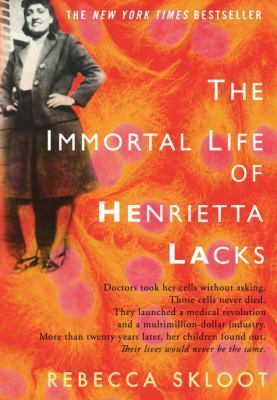
The Immortal Life of Henrietta Lacks
Rebecca Skloot
We may earn a commission on purchases — at no cost to you. As an Amazon Associate we earn from qualifying purchases. Disclosure.
The Immortal Life of Henrietta Lacks is Rebecca Skloot's non-fiction narrative about Henrietta Lacks, a Black woman whose cells were taken without her consent in 1951 and used to create the HeLa cell line, which became foundational to modern medical research. Skloot traces Henrietta's life, her family's story and her cells' enormous contributions to medicine, asking who benefits from medical innovation and who pays the price. It is a story of medical exploitation, racial injustice and a woman whose contribution to science was stolen and unacknowledged.
- 1Henrietta Lacks was a Black woman living in Baltimore with a family and limited access to healthcare when she was diagnosed with cervical cancer in 1951.
- 2During her treatment at Johns Hopkins Hospital, cells were taken from her tumour without her consent or knowledge.
- 3Her cells, renamed HeLa, became the first immortal human cell line and have been used in countless medical advances, including the development of the polio vaccine and vaccines for measles and mumps.
- 4Henrietta died of her cancer shortly after the cells were taken, and she and her family were never credited or compensated for the cells' use.
- 5Her family lived in poverty for decades while her cells were worth millions and were used in medical research worldwide.
- 6Skloot's book traces both Henrietta's life and her family's belated discovery of what happened to Henrietta's cells and their efforts to gain recognition and compensation.
Key ideas
Medical exploitation and racism
Skloot documents a history of medical professionals taking advantage of Black patients, using them as research subjects without consent. Henrietta's case is not an isolated incident but part of a pattern of exploitation.
The invisibility of labour
Henrietta's cells have been used in countless medical advances and experiments, yet her name and her family were invisible in the history of medicine. The labour of her cells went entirely uncompensated and unacknowledged.
Consent and bodily autonomy
Skloot emphasises the violation of taking Henrietta's cells without consent. The issue of who has the right to profit from a body and its parts is central to the book's moral argument.
Poverty and access
Henrietta and her family were poor and had limited access to healthcare. This vulnerability made them targets for exploitation and left them unable to protect their own interests.
The power of telling the story
Skloot's book and the renewed attention to Henrietta's story has led to changes in research ethics and compensation for those whose cells are used. Skloot argues that telling the story is a form of justice.
Family and legacy
The book traces not only Henrietta's life but her family's discovery of her contribution to science and their efforts to claim her legacy and gain recognition for her sacrifice.
Who is it for?
Readers interested in medical ethics, history or racial justice will find this essential and moving. It suits anyone interested in how science and business intersect, or in the human stories behind medical innovations. Readers of The Shock Doctrine or Nickel and Dimed will appreciate Skloot's focus on how systems exploit the vulnerable.
Full summary
Henrietta Lacks was a Black woman living in Baltimore in 1951 when she was diagnosed with cervical cancer and admitted to Johns Hopkins Hospital for treatment.
At the hospital, cells were taken from her cervix without her knowledge or consent during a biopsy for her cancer treatment. These cells were sent to a laboratory for research.
The cells, which the researchers renamed HeLa (from the first and last names of Henrietta Lacks), turned out to be immortal: they could divide indefinitely and survive outside the body.
This property made HeLa cells incredibly valuable for medical research. They were used to develop the polio vaccine, to study the effects of radiation and toxins, and to advance countless areas of medical science.
Henrietta died of her cancer just months after the cells were taken. Her family was not informed that her cells had been taken or that they were being used in research.
For decades, HeLa cells were used in medical research worldwide, and the cell line became enormously profitable. Yet Henrietta and her family lived in poverty and had no idea of the cells' value or impact.
Skloot traces the journey of Henrietta's family discovering what had happened and learning about the cells' contributions to medicine. She documents the family's efforts to gain recognition and compensation for Henrietta's contribution.
The book is both a biography of Henrietta and a critique of medical ethics and racial exploitation. Skloot uses Henrietta's story to illustrate larger patterns of how vulnerable populations have been exploited in the name of medical progress.