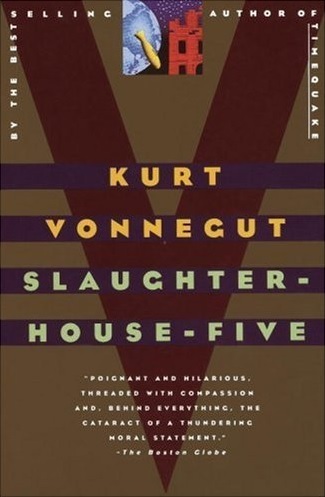
Slaughterhouse-Five
Kurt Vonnegut Jr.
We may earn a commission on purchases — at no cost to you. As an Amazon Associate we earn from qualifying purchases. Disclosure.
Slaughterhouse-Five is Kurt Vonnegut's dark comic masterpiece about Billy Pilgrim, a man who becomes unstuck in time and experiences moments from his life non-sequentially, including his experience as a prisoner of war during the firebombing of Dresden in World War II. Through Billy's journey across time and his encounter with alien philosophers on the planet Tralfamadore, Vonnegut critiques war, explores free will and mortality, and suggests that acceptance of fate is the only sane response to a universe that is indifferent to human suffering.
- 1Billy Pilgrim becomes unstuck in time after experiencing the horrors of war, and the novel follows him jumping between moments of his life: childhood, military service, middle age.
- 2Billy is a prisoner of war during the firebombing of Dresden, one of World War II's most catastrophic bombing campaigns, which kills tens of thousands of civilians.
- 3Billy is abducted by aliens from Tralfamadore and transported to their planet, where he learns their philosophy: all moments in time exist simultaneously, and the future is fixed and cannot be changed.
- 4Billy's marriage, his career and his family are rendered in the same non-sequential way as his war experiences, suggesting that all of life is equally arbitrary and predetermined.
- 5Vonnegut employs dark humour and science fiction to explore the absurdity of war and the impossibility of free will.
- 6The novel ends with Billy accepting his fate and seeking peace through the understanding that everything that will happen has already happened and cannot be changed.
Key ideas
The absurdity of war
Vonnegut's depiction of war is grotesque and darkly comic, suggesting that war is fundamentally absurd and that trying to make moral sense of it is futile. The firebombing of Dresden is presented as an atrocity that serves no strategic purpose.
Free will as illusion
The Tralfamadorian philosophy, that all moments in time exist simultaneously and the future is fixed, serves as Vonnegut's exploration of whether humans have any agency or whether we are just experiencing predetermined moments.
The randomness of survival
Billy survives the firebombing of Dresden through pure chance, protected by the shelter of a meat locker while thousands around him burn. Vonnegut suggests that survival in war is random and meaningless.
Acceptance as wisdom
The Tralfamadorian response to death and suffering is acceptance: knowing that death is inevitable, why dwell on it? This philosophy is presented as both comforting and deeply disturbing.
Mental illness as sanity
Billy's mental illness and his belief in his alien abduction can be read as either delusional or as the only sane response to an insane world. Vonnegut leaves this deliberately ambiguous.
The power of narrative form
Vonnegut's non-linear structure and his repeated phrases ('So it goes') mirror Billy's experience of time. The form becomes inseparable from the content.
Who is it for?
Readers who love war literature that critiques rather than glorifies, or who want philosophical fiction that questions free will and meaning, will find this essential. It suits anyone interested in how literature can address trauma or anyone who appreciates dark humour and experimental form. Readers of Catch-22 will appreciate Vonnegut's absurdist critique of war.
Full summary
Billy Pilgrim, the protagonist, becomes unstuck in time after his service as a soldier in World War II. The novel jumps between moments of his life without chronological order, following Billy's experience.
As a young soldier, Billy is captured during the Battle of the Bulge and becomes a prisoner of war. He and other prisoners are taken to Dresden, Germany, just as the city is about to be firebombed.
During the firebombing of Dresden, one of World War II's most devastating bombing campaigns, Billy and the other prisoners are sheltered in an underground meat locker. When they emerge, the city is completely destroyed and tens of thousands of civilians are dead.
Billy's experience of the bombing is trauma that fundamentally fractures his mind. He begins to experience moments from his life non-sequentially, sometimes existing as a young soldier, sometimes as a middle-aged man.
At some point in his life, Billy is abducted by aliens from the planet Tralfamadore. The Tralfamadorians reveal to Billy their philosophy: all moments in time exist simultaneously, and the future is fixed and unchangeable. Death, therefore, is not an ending but simply a moment that happens.
Billy applies this Tralfamadorian philosophy to his life. He marries a woman named Valencia, has children, and becomes an optometrist. But his life is as predetermined as his war experience, and he experiences these moments as fragments.
Vonnegut uses dark humour and repeated phrases ('So it goes') to describe deaths and ordinary moments alike, suggesting that all moments are equally significant and insignificant.
The novel ends with Billy at peace, having accepted the Tralfamadorian wisdom. He has learned to face death with equanimity and to experience his life not as a narrative progressing toward meaning but as a collection of moments.