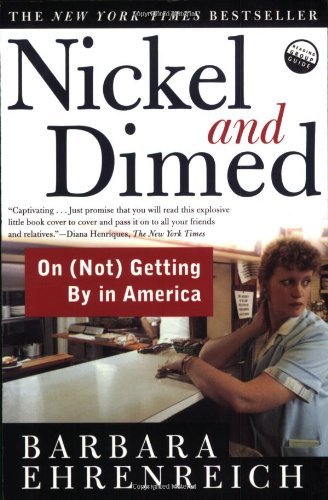
Nickel and Dimed: On (Not) Getting By in America
Barbara Ehrenreich
We may earn a commission on purchases — at no cost to you. As an Amazon Associate we earn from qualifying purchases. Disclosure.
Nickel and Dimed is Barbara Ehrenreich's non-fiction investigation into the lives of low-wage workers in America, exploring the economic realities of trying to survive on minimum wage jobs.
- 1Ehrenreich works low-wage jobs to experience the reality of minimum wage workers.
- 2She documents the economic challenges of affording basic necessities on these wages.
- 3The book explores multiple low-wage jobs and multiple locations in America.
- 4Ehrenreich reveals systemic barriers that keep low-wage workers in poverty.
- 5The investigation challenges assumptions about poverty and work ethic.
- 6Ehrenreich advocated for policy changes to address low-wage worker challenges.
Key ideas
Economic reality
Ehrenreich reveals how minimum wage makes it nearly impossible to afford basic necessities.
Systemic barriers
Low-wage workers face structural barriers beyond individual responsibility.
Hidden costs
Ehrenreich reveals the hidden costs of poverty that those with means often don't see.
The working poor
She portrays people working full-time who still cannot meet their basic needs.
Corporate exploitation
Ehrenreich critiques how corporations profit from low-wage labour.
Policy advocacy
Ehrenreich uses investigation to advocate for better wages and working conditions.
Who is it for?
Readers interested in social commentary, economics and the reality of working-class life will find this essential and eye-opening. It suits anyone interested in understanding poverty and economic inequality.
Full summary
Ehrenreich leaves her professorial life to work low-wage jobs as an undercover investigation.
She works as a waitress, housecleaner and retail worker in different parts of America.
Through her jobs, she experiences the reality of trying to survive on minimum wage.
She documents the monthly struggle to afford housing, food, transportation and other basics.
She reveals how employers exploit low-wage workers and extract maximum labour.
She explores how low-wage workers juggle multiple jobs and still fall short financially.
She interviews other low-wage workers and documents their strategies for survival.
Ehrenreich concludes with analysis of what must change to support low-wage workers.