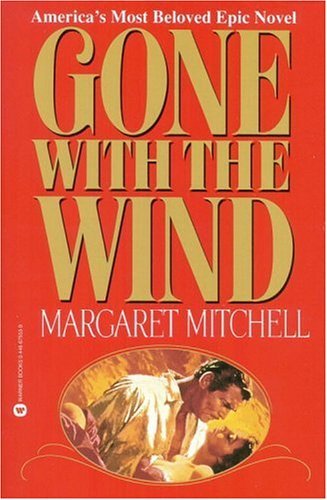
Gone with the Wind
Margaret Mitchell
We may earn a commission on purchases — at no cost to you. As an Amazon Associate we earn from qualifying purchases. Disclosure.
Gone with the Wind is Margaret Mitchell's epic historical romance set during the American Civil War and Reconstruction, following Scarlett O'Hara, a vain, ambitious young woman who schemes, manipulates and survives the destruction of the Old South. Rhett Butler, a cynical and charming smuggler, loves Scarlett, and their passion and conflicts drive much of the narrative. The novel is both a love story and a portrait of a way of life collapsing, rendered with complexity and without moral simplicity.
- 1Scarlett O'Hara is a young woman from a planter family in Georgia, vain, ambitious and willing to do whatever is necessary to survive.
- 2The novel spans from before the Civil War through the Reconstruction era, showing how the war destroys the social and economic order of the South.
- 3Scarlett's love interests include Ashley Wilkes, a gentleman planter from a neighbouring family, and Rhett Butler, a smuggler and adventurer who both challenges and attracts her.
- 4Rhett loves Scarlett but is clear-eyed about her nature: she is selfish and driven by desire for power and wealth, not by romantic love.
- 5The novel portrays the South's transformation from a wealthy agrarian society to a defeated, impoverished region struggling to rebuild.
- 6Scarlett's survival instinct and willingness to do whatever is necessary to maintain her position make her both admirable and despicable.
Key ideas
Female ambition and selfishness as survival
Mitchell treats Scarlett's ambition and selfishness without moral judgment, showing how these traits allow her to survive when others are destroyed by loyalty or principle. Scarlett's willingness to set aside morality in pursuit of survival is portrayed as practical rather than evil.
The destruction of an order
The novel is a portrait of how a way of life is destroyed by war. Mitchell shows the Old South's dependence on slavery and how that dependence undermines the social order that depends on it.
Love and pragmatism in conflict
Rhett's love for Scarlett is complicated by his clear-eyed knowledge that she does not love him and is incapable of the selflessness love requires. Their relationship is a battle between passion and pragmatism.
Class and reinvention
Scarlett uses her wiles and her willingness to do what others won't to reinvent herself and to climb socially and economically, even when her family has lost status.
The impossibility of return
The novel suggests that the Old South cannot be recovered and that those who cling to it are destroyed by their attachment. Those who survive are those willing to accept change and move forward.
Female sexuality and power
Mitchell portrays Scarlett as understanding that female sexuality and beauty are tools of power. She uses these tools without guilt, and her willingness to do so gives her agency.
Who is it for?
Readers who love historical epics and complex female protagonists will find this essential and rewarding. It suits anyone interested in American history, the Civil War era or Southern history. Readers should be aware that the novel contains references to slavery and racial attitudes that reflect the historical period and the perspective of the white Southern characters.
Full summary
Scarlett O'Hara is a young woman from a planter family in Georgia before the Civil War. She is vain, ambitious and adept at using her beauty and wit to get what she wants.
The novel opens with Scarlett pining for Ashley Wilkes, a gentleman planter from a neighbouring family. Ashley is honourable, but Scarlett loves him selfishly, wanting to possess him and his status.
She meets Rhett Butler, a cynical smuggler who is amused by Scarlett and who loves her despite, or because of, her selfishness and ambition.
The Civil War erupts, destroying the agrarian economy of the South. Plantations are burned, fortunes are lost, and the way of life of the planter class is annihilated.
Scarlett marries Ashley, who is destroyed by the war's outcome and unable to adapt to the new South. She also briefly marries another man, Charles Hamilton, for practical reasons.
After Charles's death, Scarlett marries Rhett, and their marriage is a passionate but ultimately unsuccessful attempt to bridge the gap between her selfishness and his love for her.
Through the Reconstruction era, Scarlett uses her wiles, her willingness to defy social convention and her ruthlessness to climb socially and economically, even hiring convict labour to rebuild her fortune.
The novel builds toward Scarlett's realisation that Rhett loves her but that she has driven him away through her selfishness and her fixation on Ashley. Rhett leaves, and Scarlett is left to determine whether she can change or whether her nature is fixed.