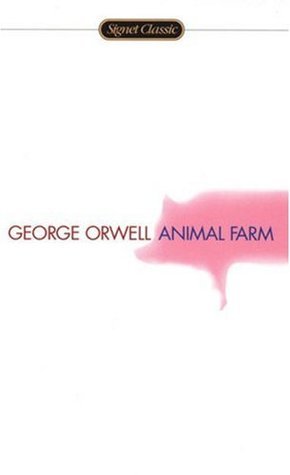
Animal Farm
George Orwell
We may earn a commission on purchases — at no cost to you. As an Amazon Associate we earn from qualifying purchases. Disclosure.
Animal Farm is George Orwell's allegorical novella about a group of farm animals who rebel against their human farmer, intending to create a society where animals will be equal, free and happy. But the pigs, the most intelligent animals, gradually seize power and become tyrants themselves, replicating and exceeding the oppression they sought to overthrow. It is a political allegory about the Russian Revolution and a warning about how revolutionary ideals can be corrupted by power.
- 1The animals of Manor Farm stage a rebellion against their human owner, Mr. Jones, inspired by the vision of an old boar named Old Major.
- 2The rebels successfully drive out the humans and rename the farm Animal Farm, establishing Seven Commandments based on the principle that all animals are equal.
- 3The pigs, most intelligent of the animals, assume leadership roles, with Napoleon and Snowball emerging as leaders.
- 4Napoleon uses dogs he has secretly trained to drive out Snowball, establishing himself as the sole leader.
- 5Over time, Napoleon and the pigs begin to accumulate privileges: they sleep in the farmhouse, eat the best food, and gradually rewrite history and the Seven Commandments.
- 6The farm gradually becomes indistinguishable from the tyranny the animals sought to escape, with the pigs becoming as oppressive as the humans had been.
Key ideas
The corruption of power
Orwell's central insight is that power tends to corrupt even those who begin with revolutionary ideals. Those who seize power often replicate the oppression they sought to overthrow.
The manipulation of language
The pigs use language to control the animals: they rewrite history, alter the Seven Commandments, and use propaganda to maintain power. Orwell shows how language can be weaponised.
Ideology versus reality
The pigs' claim to be building a society of equals is contradicted by their actions, which create new hierarchies and new oppression. Orwell shows the gap between revolutionary rhetoric and reality.
The vulnerability of collective memory
The pigs are able to rewrite history and alter the commandments because the animals have no way to remember or verify the past. Orwell suggests that control of memory is control of reality.
The tragedy of the working animal
The horse Boxer works harder than any other animal, driven by loyalty and the belief that the rebellion has created a better world. His fate is tragic and illuminates the vulnerability of workers.
The inevitability of political corruption
Orwell suggests that without constant vigilance and accountability, power will corrupt. The revolution is not a solution but only the beginning of a new cycle of oppression.
Who is it for?
Readers who want a masterpiece of political allegory will find this essential. It suits anyone interested in the history of the Russian Revolution, political philosophy or cautionary tales about the corruption of power. The novella is brief and perfectly crafted, accessible to readers of any age but with depths that reward multiple readings.
Full summary
The animals of Manor Farm, inspired by a vision from the old boar Old Major, stage a rebellion against their human owner, Mr. Jones. The rebellion succeeds, and the humans are driven away.
The animals rename the property Animal Farm and establish Seven Commandments, the most important being that all animals are equal. They envision a society where animals will work for themselves, not for human masters.
The pigs, most intelligent of the animals, take on the roles of leadership and planning. Among them, Napoleon and Snowball emerge as the principal leaders, though they often disagree on direction.
Using dogs he has secretly trained, Napoleon violently drives Snowball from the farm, establishing himself as the sole leader. The other animals are told that Snowball was a traitor working against the revolution.
Under Napoleon's leadership, the pigs gradually begin to assert privileges: they sleep in the farmhouse, they eat the best food, they work less while the other animals work harder.
The pigs rewrite the Seven Commandments to suit their changing behaviour, justifying their privileges and gradually accumulating more power and comfort.
The horse Boxer, the strongest and most loyal animal, works tirelessly, believing in the revolution and in Napoleon's leadership, even as conditions deteriorate for the other animals.
Orwell ends the novella with the pigs becoming indistinguishable from the humans they replaced. The final commandment is altered to: 'All animals are equal, but some animals are more equal than others,' a perfect encapsulation of the revolution's corruption.